

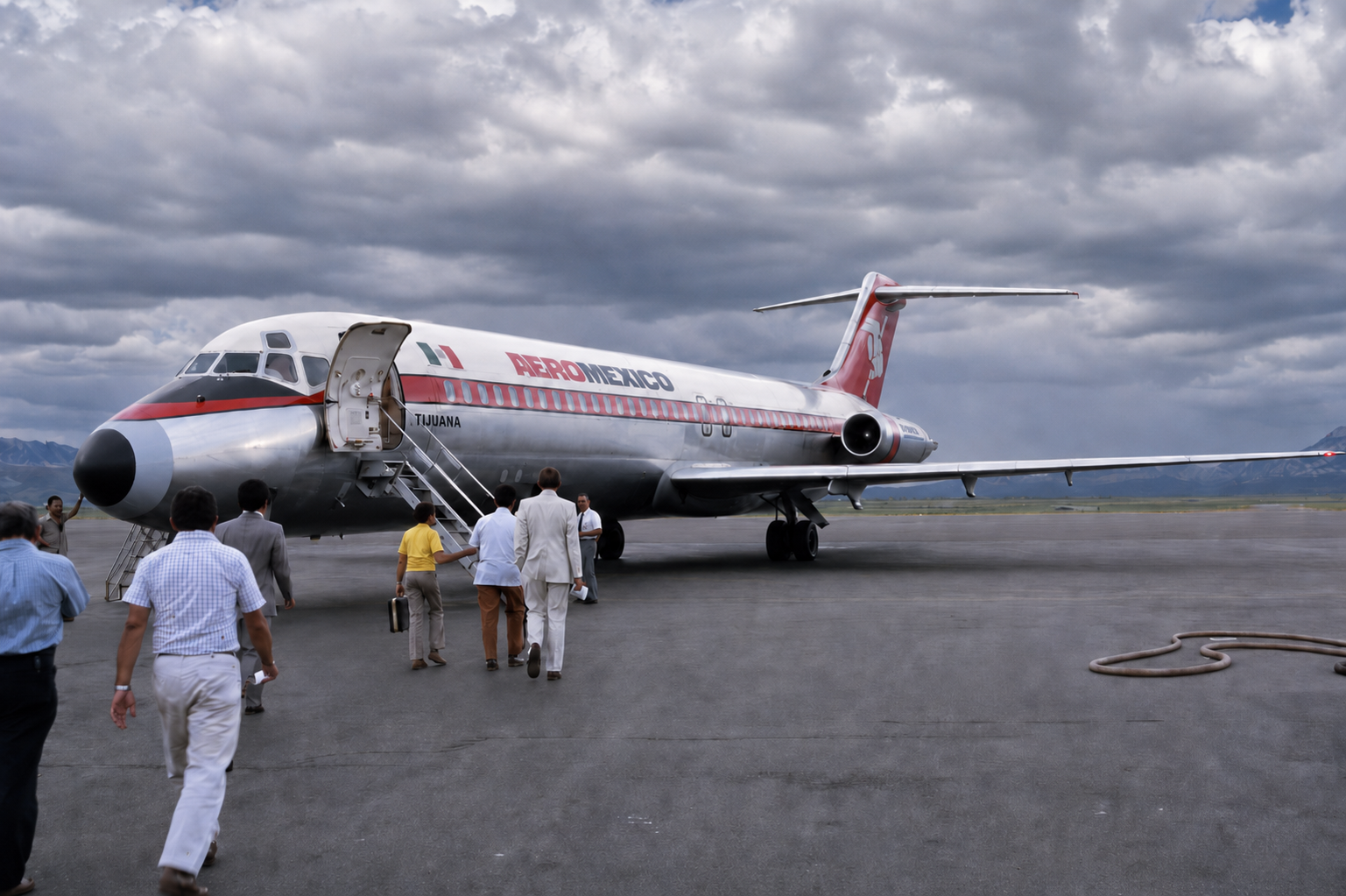
Aeroméxico accidents span more than nine decades of flying under three names: Aeronaves de México, founded in 1934, Aerovías de México and, since 1972, Aeroméxico. Over that time the airline has carried hundreds of millions of passengers. Its record includes a string of fatal accidents between 1958 and 1986, one hijacking and a 2018 takeoff crash in Durango that all 103 people on board survived. This piece goes through each of those events: what happened, why, and what changed afterward.
From Aeronaves de México to Aeroméxico: Three Names, One Airline
Antonio Díaz Lombardo founded Aeronaves de México on September 14, 1934. The first flight, flown by Julio Zínser in a Stinson SR, connected Mexico City and Acapulco. By 1968 the carrier had become the first in Latin America to fly an all-jet fleet (DC-8s and DC-9s), after retiring its last piston airplane, a DC-6.
The new name and the “eagle knight” logo the airline still uses arrived in 1972, when Aeronaves de México officially became Aeroméxico. The Mexican government took over the airline in 1988 after a financial crisis and sold it back to private owners in 2007. Aeroméxico went through Chapter 11 bankruptcy in the United States during the pandemic, filing in 2020 and emerging in 2022.
Fatal Aeroméxico Accidents, One by One
Flight 111 (1958): The Crash Guadalajara Never Forgot
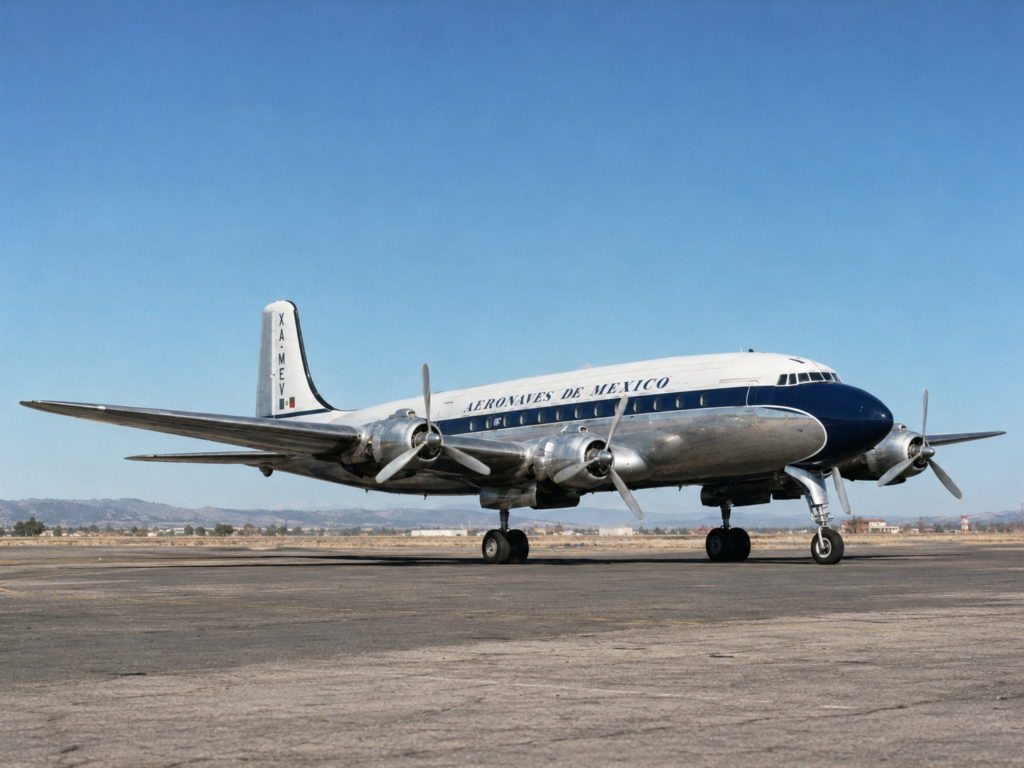
On June 2, 1958, a Lockheed L-749 Constellation was flying a Tijuana–Mazatlán–Guadalajara–Mexico City–Acapulco multi-stop route. Two minutes after taking off from Guadalajara, at 10:06 p.m., it slammed into Cerro de las Latillas, also known as El Picacho, in the municipality of Tlajomulco de Zúñiga, Jalisco. All 46 people on board died: 39 passengers and seven crew members.
It was raining hard that night and visibility was poor. Investigators pointed to a late turn in the departure procedure that took the airplane too close to the hill, combined with mechanical trouble in the Constellation’s four engines. At the time it was the worst disaster in Mexican commercial aviation.
Flight 229 (1973): Into the Mountains Near Puerto Vallarta
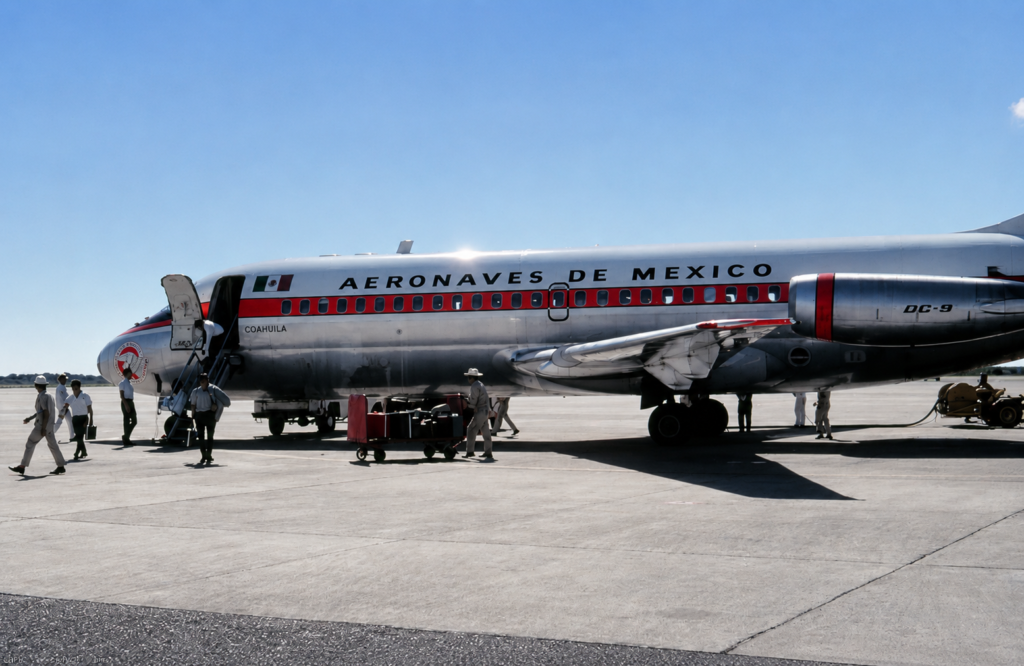
On June 20, 1973, a McDonnell Douglas DC-9 (XA-SOC) was flying Houston–Monterrey–Puerto Vallarta–Mexico City. At 10:47 p.m., already cleared to approach runway 04 at Puerto Vallarta airport, it struck Las Minas mountain, 37 kilometers (23 miles) south-southeast of the airport. All 27 people on board, 22 passengers and five crew members, were killed.
Air traffic control lost contact with the crew at 10:50 p.m. The investigation found that the jet did not slow down during its descent pattern and drifted out of the bay area toward the sierra.
Flight 230 (1981): The Chihuahua Storm
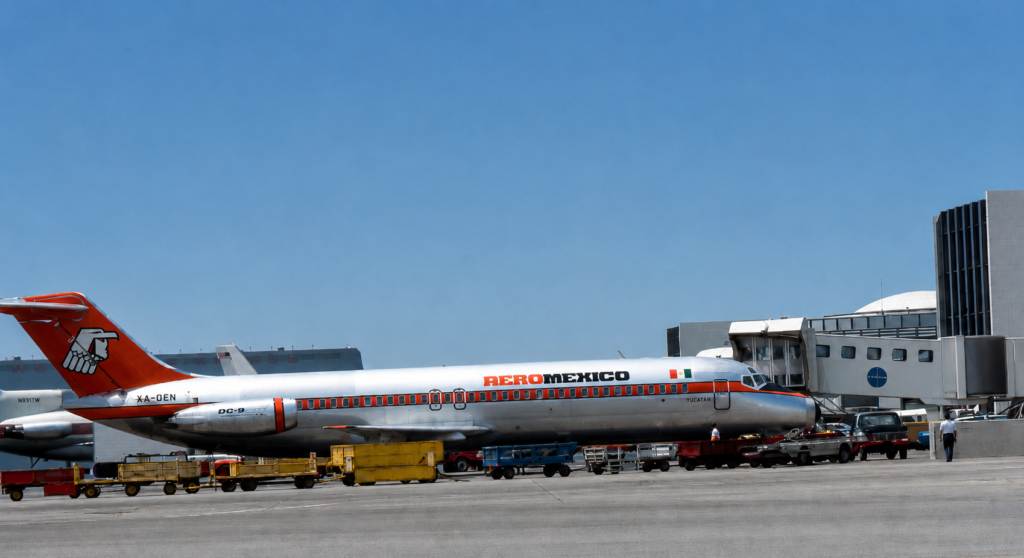
On July 27, 1981, the DC-9-32 named “Yucatán” (XA-DEN) was flying from Monterrey to Tijuana with stops in Chihuahua and Hermosillo. On approach to Chihuahua, through cumulonimbus clouds with strong gusts and heavy rain, the airplane bounced on touchdown and then hit the ground very hard. It ran off the runway, broke apart and caught fire.
Of the 66 people on board (60 passengers and six crew), 34 made it out of the wreckage. The 32 who were trapped died from smoke and fire. The cause was put down to loss of control in the storm’s downdrafts and turbulence.
Flight 110 (1981): Decompression Over the Guerrero Sierra
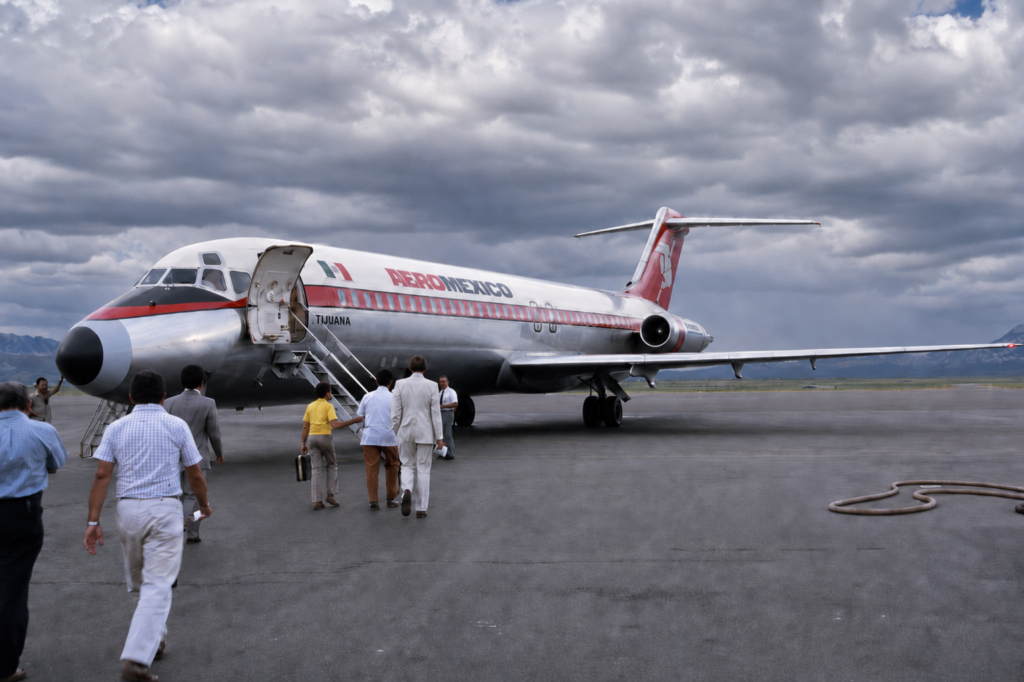
Barely three and a half months after Chihuahua, on November 8, 1981, another Aeroméxico DC-9-32 (XA-DEO), this time flying Acapulco to Guadalajara, suffered a cabin decompression at 31,000 feet. The captain reported the problem and asked to return to Acapulco, starting an emergency descent. At 6,000 feet the airplane hit the Guerrero sierra near Zihuatanejo. All 18 people on board died.
The exact cause of the decompression was never pinned down. Investigators said the crew did not follow the emergency procedures for that kind of failure correctly.
Flight 498 (1986): The Cerritos Collision That Changed U.S. Airspace Rules
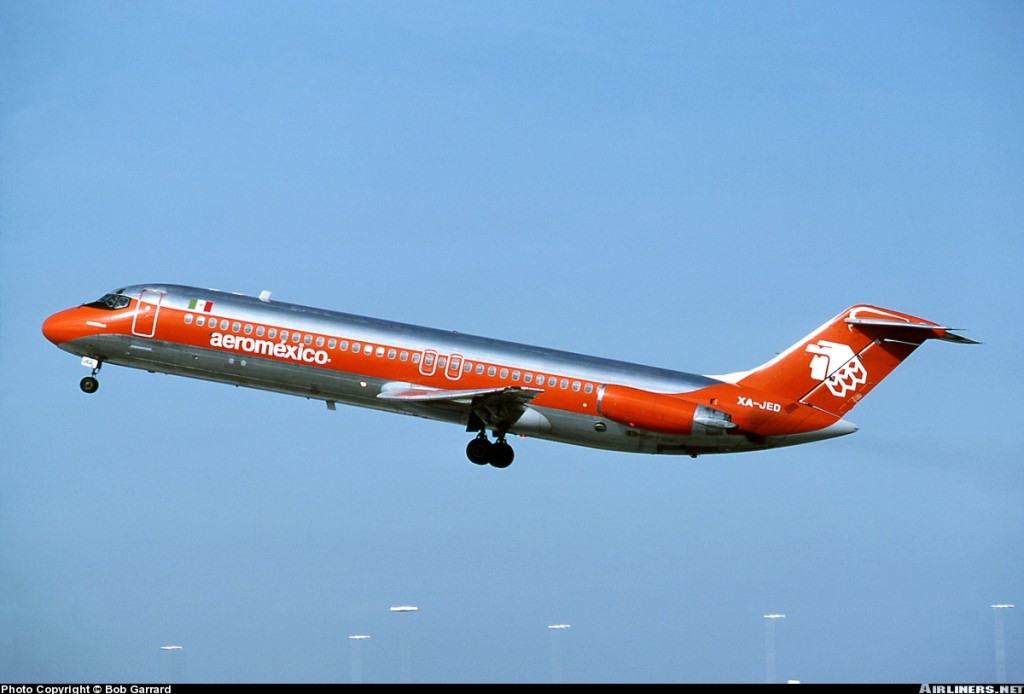
By death toll, this is the worst accident in Aeroméxico’s history, and one of the most studied in aviation anywhere. On August 31, 1986, Flight 498, a DC-9-32 registered XA-JED and nicknamed “Hermosillo,” was flying from Mexico City to Los Angeles with stops in Guadalajara, Loreto and Tijuana. At 11:52 a.m., as it descended toward LAX, a privately owned Piper PA-28 Cherokee flown by a private pilot strayed without clearance into the Los Angeles Terminal Control Area (TCA).
The Piper hit the top of the DC-9’s horizontal stabilizer at nearly a right angle, shearing it off along with part of the vertical stabilizer and the rudder. With its tail torn apart, the Aeroméxico jet rolled out of control and dove into the backyard of a house in Cerritos, California, where it exploded on impact. The blast destroyed four more homes and damaged seven others.
All 64 people on the DC-9, the three on the Piper and 15 people on the ground were killed: 82 deaths in total. The investigation by the NTSB (the U.S. National Transportation Safety Board) found no fault with the Aeroméxico crew or the aircraft. Responsibility was split between the Piper pilot, who flew into controlled airspace without clearance, and the FAA, over shortcomings in air traffic control in that area.
The regulatory fallout was immediate and lasting. The FAA required airliners operating in U.S. airspace to carry a traffic alert and collision avoidance system (TCAS), and required general aviation aircraft like the Piper to carry Mode C transponders that report altitude to controllers. TCAS is now a global standard, and much of its regulatory origin traces straight back to this accident.
The 2009 Hijacking: The Only Time Someone Seized an Aeroméxico Jet
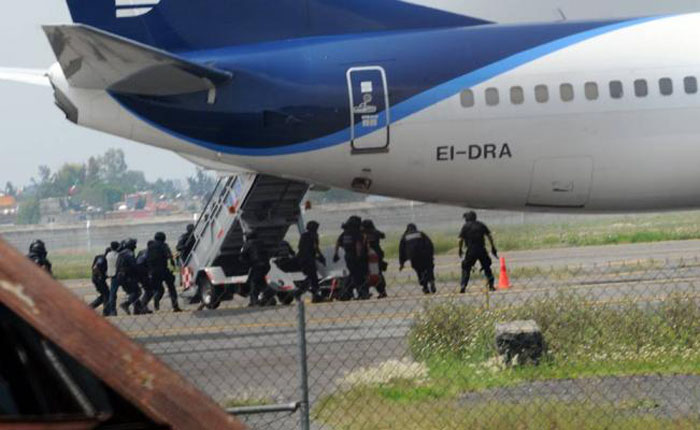
On September 9, 2009, a 44-year-old Bolivian preacher hijacked Aeroméxico Flight 576, a Boeing 737 (XA-DRA) flying from Cancún to Mexico City with 104 passengers. He claimed to be carrying three bombs and demanded to speak with then-President Felipe Calderón.
The jet landed in Mexico City and every passenger was evacuated without injury. Heavily armed police boarded the airplane and subdued the hijacker, then found that his “explosives” were empty juice cans filled with sand. It remains the only hijacking on record in Aeroméxico’s history.
The “Durango Miracle” (2018): All 103 Survived
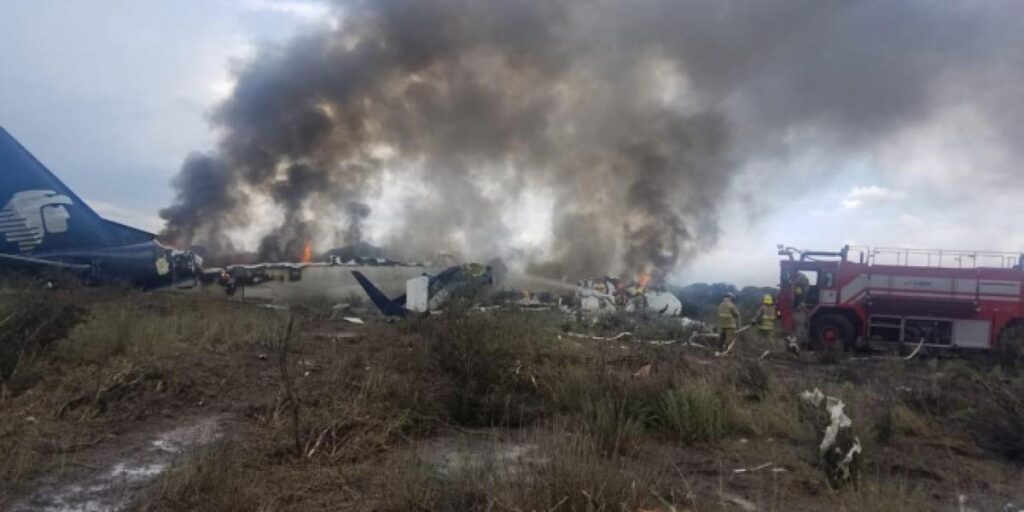
On July 31, 2018, Aeroméxico Connect Flight 2431, an Embraer 190 registered XA-GAL, was taking off from Durango International Airport for Mexico City. Moments after lifting off, it flew into a microburst, a sudden, localized wind shear that robbed it of speed and altitude in an instant.
The jet hit the runway, its engines broke away and it slid past the end of the runway before stopping, already on fire. Everyone on board, all 103 people, survived.
Mexico’s civil aviation authority concluded that the microburst was the main cause and that the pilots had not been warned about the adverse conditions before takeoff. Based on the cockpit voice recorder, the report also found that unauthorized pilot training was taking place: a trainee pilot sat in the first officer’s seat and was flying the airplane at takeoff. The case is widely known in Mexico as “El Milagro de Durango,” the Durango Miracle.
How Safe Is Aeroméxico Today?
Aeroméxico has not had a fatal accident since 1986. Its fleet today is made up of Boeing 737s and 787s, plus Embraer 190s flown by Aeroméxico Connect, an almost complete turnover from the DC-9s and DC-8s involved in the accidents of the 1970s and ’80s described here. The gap between that era and this one is no accident. It is the cumulative result of four decades of regulatory changes, many of them, like TCAS, born directly from crashes such as Cerritos.
Summary Table: Major Aeroméxico Accidents and Incidents
| Year | Flight | Location | On board | Deaths | Cause |
|---|---|---|---|---|---|
| 1958 | 111 (Aeronaves de México) | Tlajomulco, Jalisco | 46 | 46 | CFIT, bad weather and possible mechanical failure |
| 1973 | 229 | Puerto Vallarta | 27 | 27 | CFIT on approach |
| 1981 | 230 | Chihuahua | 66 | 32 | Crash landing in a storm |
| 1981 | 110 | Zihuatanejo | 18 | 18 | Cabin decompression |
| 1986 | 498 | Cerritos, California | 67 (both aircraft) | 82 (incl. 15 on the ground) | Midair collision with an unauthorized light aircraft |
| 2009 | 576 | Cancún–Mexico City | 104+ | 0 | Hijacking (no real explosives) |
| 2018 | 2431 (Connect) | Durango | 103 | 0 | Microburst on takeoff |
Frequently Asked Questions
What was Aeroméxico’s worst accident?
Flight 498 in 1986, the midair collision over Cerritos, California, with 82 deaths. It is also one of the accidents that most changed air traffic rules in the United States.
Has Aeroméxico had any recent fatal crashes?
No. The last fatal accident was in 1986. The most recent accident that destroyed an aircraft happened in 2018 in Durango, and all 103 people on board survived.
What was the “Durango Miracle”?
That’s the popular name for the 2018 crash of Aeroméxico Connect Flight 2431, an Embraer 190 that went down on takeoff in a microburst. All 103 people on board survived.
Are Aeroméxico and Aeronaves de México the same airline?
Yes. Aeronaves de México, founded in 1934, changed its name to Aeroméxico in 1972. It’s the same company under a new brand, not a successor or a different airline.
Recommended reading
- Voepass Flight 2283: did wing icing bring down the ATR 72?
- Is turbulence getting worse?
- Aeroméxico pilots’ strike: what it means for your flight (in Spanish)
- NetJets jet crashes on Loop 20 in Laredo (in Spanish)
- Aerus plane crashes in Pesquería, Nuevo León (in Spanish)