

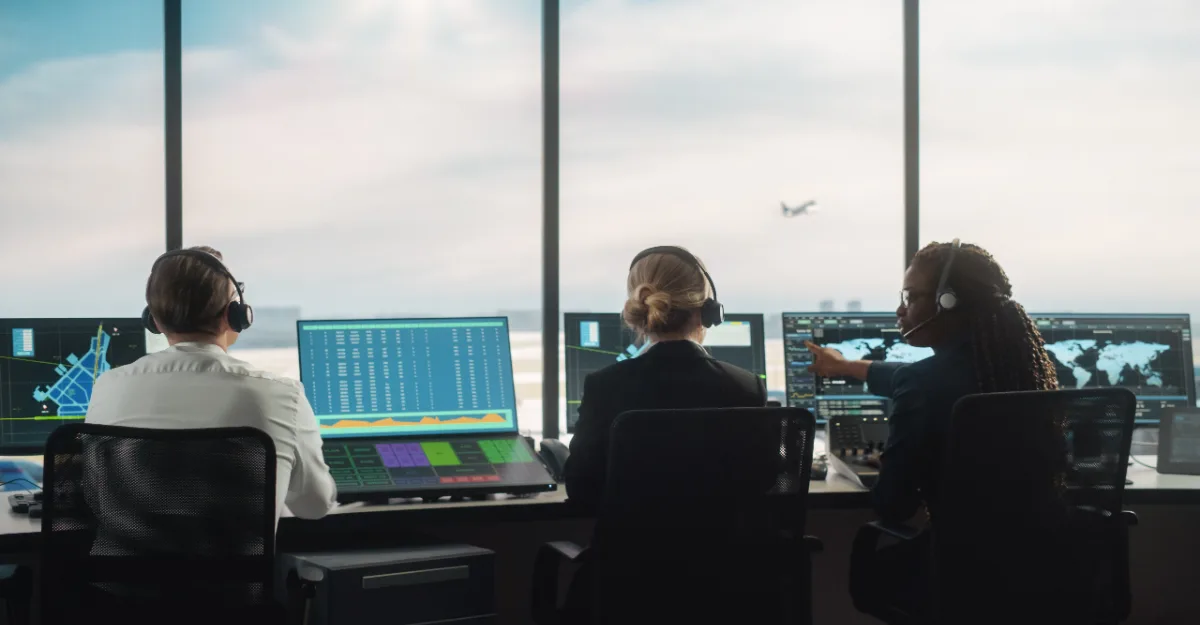
Air traffic controllers in Mexico are federal employees. They work for SENEAM, the agency under the SICT (the federal transportation ministry) that runs traffic in the country’s airspace, and every aircraft that takes off, crosses Mexican territory and lands depends on them to keep proper separation. The FAA outage of November 19, which grounded flights to the United States, put the profession back in the conversation. In Mexico, though, the real question is different: how many controllers there are, and whether that is enough.
Aeronotas reviewed the most recent performance audit of SENEAM by the Auditoría Superior de la Federación (ASF), Mexico’s federal audit office, and the current call for new controller trainees. They are the two official sources that put numbers on the table.
How many air traffic controllers does Mexico have
The latest official figure is from 2021. At the end of that year SENEAM had 1,014 filled positions, and 808 of them were air traffic controllers, 79.7% of the positions on record. The ASF documented this in audit 2021-0364, using data supplied by the agency itself.
Growth over three years was minimal:
| Year | Air traffic controllers at SENEAM |
|---|---|
| 2019 | 781 |
| 2020 | 800 |
| 2021 | 808 |
That is 27 more controllers between 2019 and 2021, an increase of 3.5%. SENEAM has not published an updated headcount since, so any later number in circulation comes from the union or from press statements, not from an official record.
By the numbers (2021, ASF): 808 controllers · 1,014 filled positions in the reviewed base · 4 area control centers · 28 control sectors · 172 positions requested from the Finance Ministry · 118 approved
Where SENEAM’s air traffic controllers work
Mexican airspace is split among four area control centers. Each is divided into sectors, and each sector is handled by its own team of controllers:
| Area control center | Sectors |
|---|---|
| Mexico City | 11 |
| Mazatlán | 6 |
| Mérida | 6 |
| Monterrey | 5 |
| Total | 28 |
On top of those centers are the control towers and approach facilities at each airport, which handle takeoffs, landings and traffic near the runways. The Mexico City center carries the heaviest load: it covers the Valley of Mexico, home to AICM, AIFA and Toluca, and the area where the work described in our piece on the AICM renovation is concentrated.
How many air traffic controllers is Mexico short
There is no official shortage figure. What does exist is the staffing needs estimate SENEAM gave the ASF for 2021, center by center:
| Center | Staffing needs reported by SENEAM (2021) |
|---|---|
| Mexico City | 27 supervisors and 114 controllers |
| Mazatlán | 12 supervisors, 41 radar controllers, 22 procedural (non-radar) controllers and 1 Topsky specialist |
| Mérida | 3 supervisors, 7 radar controllers and 22 procedural controllers |
| Monterrey | 13 procedural controllers |
Added up, that is 42 supervisor positions and 219 controller positions. The audit does not say whether each line is a pure vacancy or the staffing each center needs to cover its shifts, so the total should not be read as “261 missing.” It does show where the pressure was: the Mexico City center because of volume, and Mazatlán, which covers much of the Pacific, because of its mix of radar and procedural control.
The method for calculating how many controllers a facility needs is also on paper. SENEAM approved it on March 1, 2022: multiply the hours each position must be staffed per year, including shift handovers, and divide by the average hours a controller actually works once absences are subtracted.
Using that kind of calculation, on June 7, 2021 SENEAM asked the SICT to request 172 permanent positions from the Finance Ministry, citing the growth in operations with the Valley of Mexico airport system. Finance approved 118, effective July 1, 2021. By year’s end 41 had been filled through internal promotions: 18 controllers and 23 technicians. New hiring was left for later, once those promotions freed up entry-level slots.
Context: a controller is not trained in a few months. SENEAM’s course starts in March 2027 for those who pass a selection process that began in September 2026, and after the classroom comes certification on each position. A position approved today does not put a controller at the console tomorrow.
Shifts and fatigue among air traffic controllers
The ASF found that in 2021 SENEAM had not set minimum and maximum workload values for its controllers, even though the aviation authority’s mandatory human factors circular calls for them. Nor did it document whether actual workloads stayed within a safe range.
On fatigue, the finding was harsher. SENEAM’s own Operational Safety office had concluded, from 2020 and 2021 reports, that tiredness was a contributing factor in safety events. It drafted a circular to manage it, with concrete proposals: enough staff for fair shift rotations, rules for distributing overtime and criteria for waiting on relief. That circular, dated November 15, 2021, was canceled. The ASF concluded that in 2021 the agency did not put fatigue prevention measures in place.
That is the link between headcount and safety. With too few controllers, shifts get covered with overtime, and overtime is exactly what the agency’s own safety office wanted regulated.
Licenses and training
Of the 808 controllers in 2021, 220 (27.2%) were listed with “paperwork pending to update license.” SENEAM explained these were validity extensions issued by the AFAC while it processed the final license, with paperwork slowed by the pandemic, and that in some cases the authority took up to six months to respond. The ASF asked for records that would show whether any license had lapsed.
On training, 185 of the 520 courses scheduled for 2021 were delivered. In headcount the goal held up better: 2,043 people trained out of 2,476 planned, 83%.
What the air traffic controllers’ union is demanding
Controllers belong to the Sindicato Nacional de Controladores de Tránsito Aéreo (SINACTA), which sits with the SICT and SENEAM on the joint training committee the ASF reviewed. In May 2026, weeks before the World Cup, the union filed a strike notice against the SICT and the Finance Ministry. Its public demands: more staff, permanent appointments for controllers working without them, and restoring the purchasing power of their wages. The strike did not happen, and talks continued.
The union has circulated its own estimate of how many controllers are missing. Aeronotas could not check it against a SENEAM figure, because the agency does not publish its current headcount or shortfall, so we do not report it as fact. What the audit does allow us to say is that the problem did not start in 2026: in 2021 SENEAM was already asking for positions, acknowledging needs at all four centers and flagging fatigue as a risk.
Underneath it all is the budget. Without positions approved by the Finance Ministry there is no hiring, and without money for SENEAM there are no salaries to keep trained people from leaving. We covered this in our review of the AFAC budget for 2027, where the SICT also promised more resources for SENEAM.
How to become an air traffic controller in Mexico: 2026-2027 intake
The only way in is SENEAM’s training course, taught at its training center (CECASE) and at regional sites. The Mexico City call for applications for the 2026-2027 cycle, published September 22, 2026, trains Class III Air Traffic Controllers with restricted international radiotelephony and Class I Aeronautical Meteorologists. In 2026 SENEAM also opened intakes at AIFA and in Querétaro.
Requirements listed in the call:
- Mexican nationality by birth.
- Age between 18 years 6 months and 35 years when the course starts.
- Advanced conversational and written English.
- Completed high school, or a university degree with professional license.
- Meet the medical requirements of the AFAC’s Civil Aviation Medicine Regulation.
- Birth certificate, valid official ID and valid health insurance at the start of and throughout the course.
- Availability for the schedule and for travel.
The process has three stages, and each one weeds people out:
| Stage | What is evaluated | Dates (Mexico City site) |
|---|---|---|
| Registration | Application and scanned documents by email | Sep 22 to Oct 21, 2026 |
| 1 | Psychometric evaluation, in person at SENEAM offices next to AICM | Oct 26 to 30, 2026; results Dec 3 |
| 2 | Math, physics, geography and written English test, plus an online English interview | Dec 7 to 15, 2026; results Dec 17 |
| 3 | Comprehensive aviation medical exam | Jan 25 to 29, 2027 |
| Enrollment | At CECASE, Iztacalco | Jan 25 to Feb 5, 2027 |
| Start | Training course | March 16, 2027 |
Registration for the Mexico City site has closed. Anyone hoping to apply in the next cycle should watch SENEAM’s calls section on gob.mx, where intakes for other sites are posted too. The call does not mention a fee or a stipend for the course.
It is a very different path from a pilot’s, who pays for training at a private school. For comparison, see how much pilot school costs in Mexico and what a pilot earns in Mexico (both in Spanish).
What it means for passengers
A control center with fewer people does not shut down: it limits how many aircraft it accepts per hour in a sector. Passengers feel it as waits on the ramp, ground holds at the origin airport and longer approaches, especially at peak hours in the Valley of Mexico. Safety also factors into outside evaluations of the country; the FAA reviews Mexico’s aviation authority to keep its Category 1 rating.
No passenger ever sees a controller. But their numbers, their shifts and their fatigue weigh on every delay announced as “per air traffic control instructions.”
FAQ about air traffic controllers in Mexico
Who employs air traffic controllers in Mexico?
SENEAM, Servicios a la Navegación en el Espacio Aéreo Mexicano, a decentralized agency of the SICT. Positions are approved by the Finance Ministry.
How many air traffic controllers are there in Mexico?
The latest official figure is 808 controllers at the end of 2021, according to the ASF. SENEAM has not published a later number.
What is an air traffic controller’s salary in Mexico?
SENEAM does not publish a pay scale for controller positions. The union says their wages have lost purchasing power, and that is one of the points in its negotiations with the SICT and the Finance Ministry.
What does it take to become an air traffic controller?
Being Mexican by birth, aged 18 years 6 months to 35, with a high school diploma and advanced English; passing the psychometric evaluation, the knowledge and English exams and the aviation medical exam; and then completing SENEAM’s training.
Can air traffic controllers in Mexico go on strike?
They are government workers, and their union can file a strike notice with the Federal Conciliation and Arbitration Tribunal, as it did in May 2026. That notice did not end in a walkout.
Recommended reading
- FAA outage: 193 flights and 18,000 passengers affected (in Spanish)
- AFAC budget 2027: 875 million instead of the promised 1,400 (in Spanish)
- Aeroméxico pilots’ strike: what happens to your flight (in Spanish)
- How much flight attendants earn in Mexico (in Spanish)