

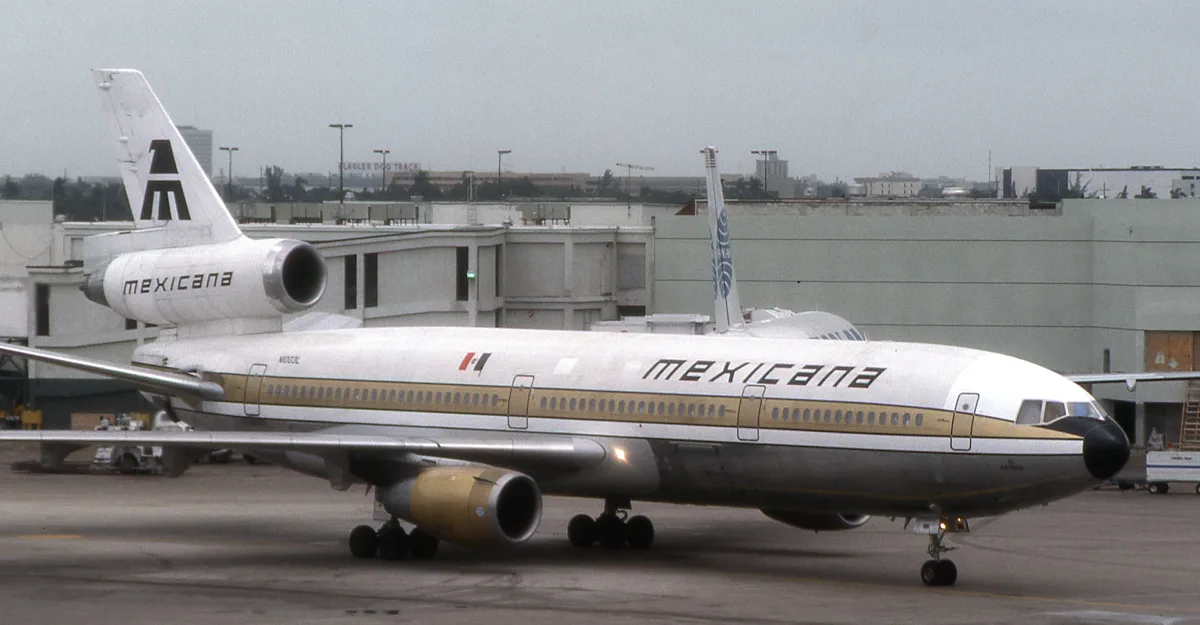
For 89 years, Mexicana de Aviación was what flying in Mexico meant. The history of Mexicana Airlines starts in July 1921 with a small company that carried mail and payrolls to the oil fields around Tampico, and it ends on August 28, 2010, when its planes stopped taking off. In between came the first jet flown by a Mexican airline, the largest Boeing 727 fleet outside the United States, and thousands of employees who still call it “la Mexicana.”
This is the story of the original Mexicana, from 1921 to 2010. Aeronotas pieced it together from corporate histories, press coverage from the era and from the bankruptcy, and specialist sources, and it flags the points where those sources disagree.
Key facts:
• Its direct forerunner, Compañía Mexicana de Transportación Aérea, was founded on July 12, 1921; Compañía Mexicana de Aviación was incorporated in August 1924.
• Pan American bought it in 1929 and remained a shareholder for almost four decades.
• In 1960 it flew the first jet operated by a Mexican airline, a De Havilland Comet 4C, between Mexico City and Los Angeles.
• The government took control in 1982, sold it in 1989, regained control through Cintra in the mid-1990s, and in 2005 Grupo Posadas bought it.
• It stopped flying on August 28, 2010, and was declared bankrupt on April 4, 2014.
Mexicana Airlines history at a glance
| Year | Event |
|---|---|
| 1921 | Compañía Mexicana de Transportación Aérea is founded (July 12) |
| 1924 | Compañía Mexicana de Aviación is incorporated and takes over CMTA’s assets |
| 1929 | Pan American buys the company; Charles Lindbergh flies the mail from Mexico to Brownsville |
| 1936 | Flights to Los Angeles begin |
| 1960 | The De Havilland Comet 4C arrives, the first jet of a Mexican airline |
| 1966 | First Boeing 727 delivered |
| 1967–1968 | Pan American sells its stake; the company passes to Mexican owners |
| 1982 | The federal government takes a majority stake |
| 1989 | Privatization |
| 1996 | Cintra is created as the holding company for Mexicana and Aeroméxico |
| 2005 | Grupo Posadas buys Mexicana |
| 2009 | Joins oneworld (November 10) |
| 2010 | Files for concurso mercantil, Mexico’s bankruptcy protection (August 2), and stops flying (August 28) |
| 2014 | Declared bankrupt (April 4) |
The beginnings: 1921 to 1929
Compañía Mexicana de Transportación Aérea (CMTA) was founded on July 12, 1921, holding the country’s first air concession, for the Mexico City–Tampico route. Its founders included two Americans, L. A. Winship and Harry J. Lawson. Its first aircraft was a Lincoln Standard biplane.
Tampico’s oil region was booming, and the roads between the capital and the coast were unsafe. The airplane was the fastest and most dependable way to move mail and, above all, the oil companies’ payrolls.
In August 1924, William L. Mallory and George L. Rihl incorporated Compañía Mexicana de Aviación (CMA), which acquired CMTA’s assets. CMA was a new company that inherited the aircraft, the concession and the operation. That is why some sources date Mexicana’s birth to 1921 and others to 1924. Both dates are right, as long as it is clear which company each one refers to.
In 1925 Sherman Fairchild bought 20% of the company, which soon added Fairchild aircraft. By the late 1920s CMA had secured a ten-year federal contract, and in 1928 it began scheduled service to Tampico and to Mérida via Veracruz.
The Pan American era: 1929 to 1967
In early 1929, Pan American Airways, run by Juan Trippe, bought Compañía Mexicana de Aviación. For Pan Am, Mexicana was the way into Mexico and the bridge to Central America.
On March 9, 1929, Charles Lindbergh flew the airmail from Mexico to Brownsville, Texas, in a Ford Trimotor. It launched international airmail service between the two countries and remains one of the best-remembered moments in the airline’s history.
Under Pan Am, Mexicana extended its network to Guatemala, El Salvador, Costa Rica and Cuba. In 1936 it started flying to Los Angeles, the first foreign airline to serve the city. Lockheed Electras, Douglas DC-2s and DC-3s and, later, DC-6s defined those decades.
After World War II, Mexican law forced Pan Am to cut its stake, first to 45% and then to 35%. Mexican capital steadily gained ground inside the company.
The Comet: the first jet of a Mexican airline
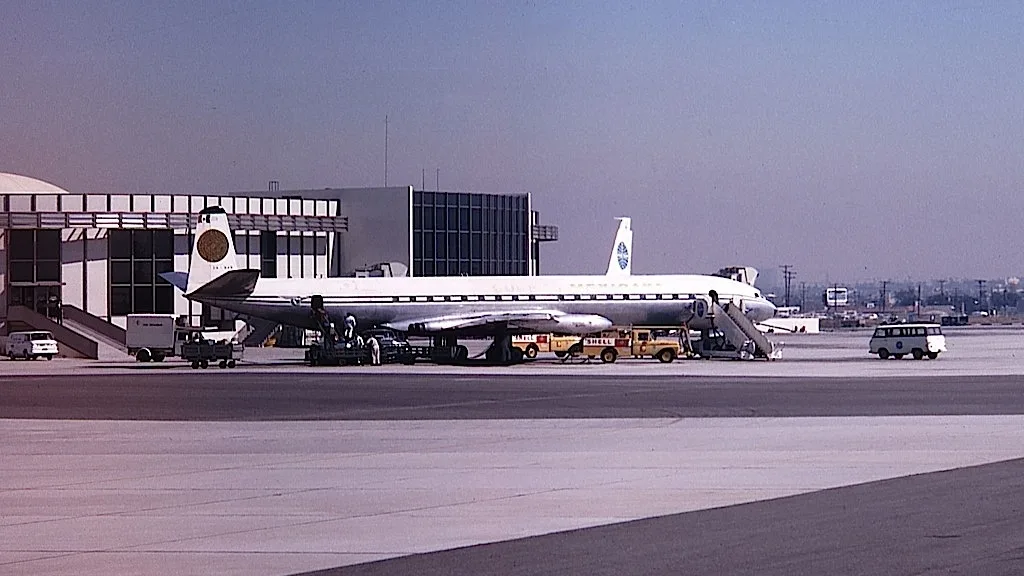
In July 1960, Mexicana brought the jet age to Mexico with the De Havilland Comet 4C on the Mexico City–Los Angeles route. It was the first jet aircraft flown by a Mexican airline. The Comets served Mexicana through the 1960s. One of them, XA-NAR, the airline’s first jet, survives in Mexicana colors at the Museum of Flight’s restoration center at Paine Field, near Seattle.
Between 1960 and 1962 a string of strikes cost the company 74.1 million pesos, and by the middle of the decade it was piling up losses.
The Boeing 727 and Mexican ownership: 1966 to 1982
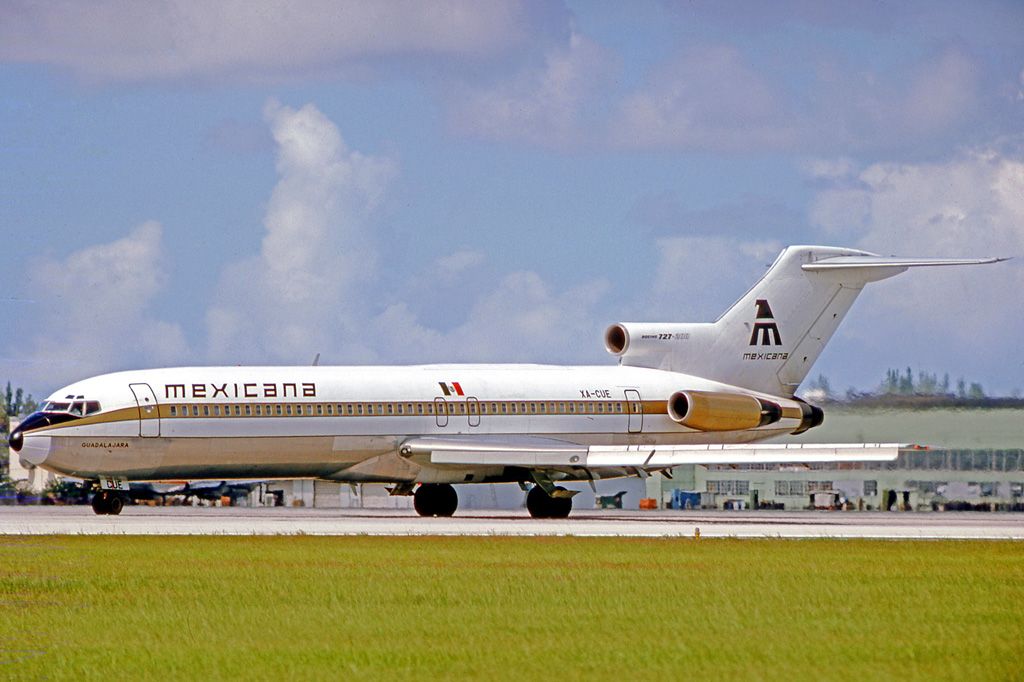
The first Boeing 727 arrived in 1966, and it became the aircraft that defined Mexicana for nearly four decades. The airline went on to run the largest 727 fleet outside the United States and flew almost 70 of them over the years.
Between 1967 and 1968, Pan American sold its remaining stake and Mexicana passed into the hands of Mexican investors. Businessman Crescencio Ballesteros led the shareholder group, and Manuel Sosa de la Vega took over as head of the airline, a central figure for decades to come.
In the 1970s Mexicana grew into one of the largest airlines in Latin America, added destinations in the United States and the Caribbean and, in 1981, took delivery of its first widebodies: McDonnell Douglas DC-10-15s, which stayed in the fleet until 1996.
From state control to privatization: 1982 to 1996
In 1982, in the middle of an economic crisis, the federal government took a majority of Mexicana’s shares. Most sources put its stake at 54%; some put it at 58%.
The government privatized the airline in 1989. An investor group, Grupo Xabre, bought 25% of the shares while the state cut its holding. In the early 1990s Mexicana bought Aerocaribe and Aerocozumel and renewed its fleet with Airbus A320s (from 1991) and Fokker 100s (from 1992).
That period produced one of the airline’s best-remembered images: a different tail design on every plane. The first flight in that livery took place in January 1991.
In 1993 Aeroméxico gained control of Mexicana through a share swap, although the two kept flying separately. After the 1994–1995 peso crisis, both airlines’ bank debts were converted into equity, and in 1996 Cintra (Corporación Internacional de Aviación) was created as a state-controlled holding company for the pair.
The final years: 2000 to 2010
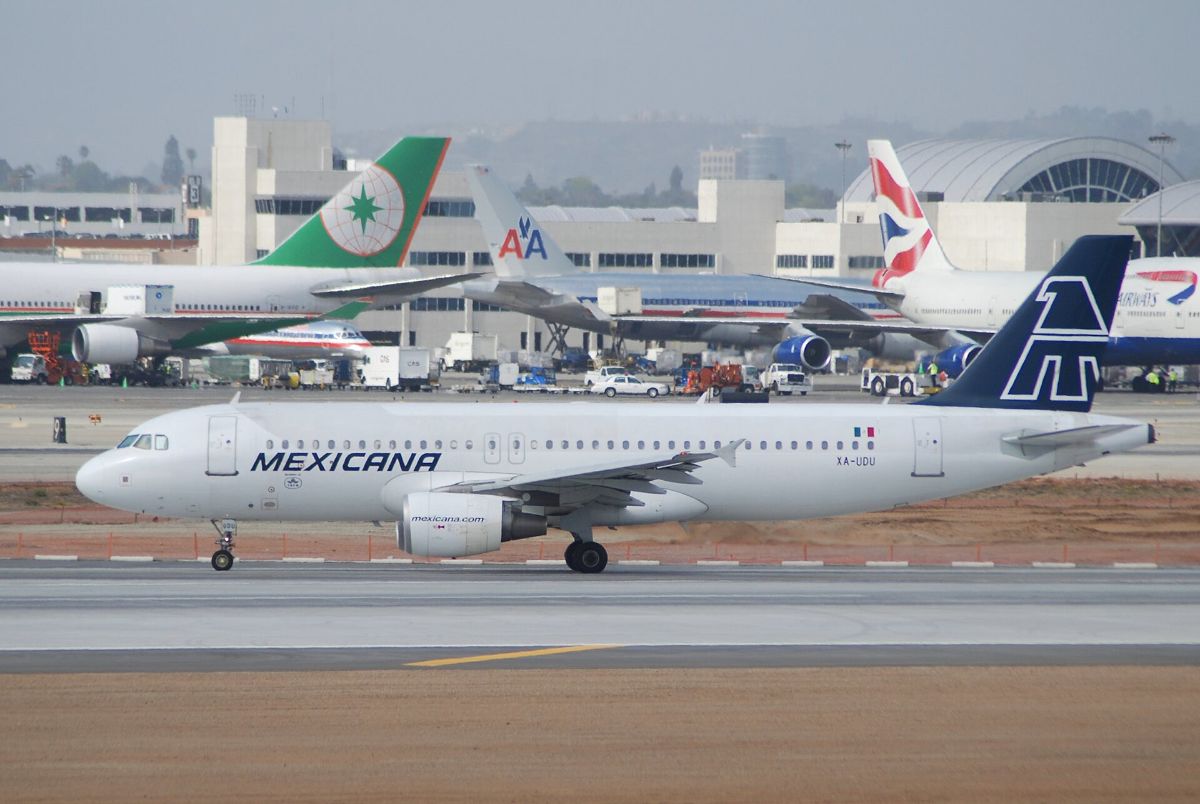
Mexicana joined Star Alliance in 2000 and left in 2004. In those years it added Boeing 767s for long routes and, in November 2004, received the first of ten Airbus A318s, becoming the first Latin American airline to fly the type. It retired its last 727s in 2003 or 2004, depending on the source.
In 2005 Mexicana set up Click Mexicana, a low-cost subsidiary flying Fokker 100s, built on Aerocaribe. Late that year Cintra sold Mexicana to Grupo Posadas, controlled by Gastón Azcárraga Andrade, for about 165 million dollars plus the airline’s liabilities.
MexicanaLink, a regional subsidiary based in Guadalajara, launched in 2009, and on November 10 of that year Mexicana joined oneworld. The same year, the recession and the H1N1 flu outbreak hit demand hard.
Mexicana in its last full year:
11.1 million group passengers in 2009 · 105 aircraft in November 2009 (63 at Mexicana, 30 at MexicanaClick and 12 at MexicanaLink) · 67 destinations in 14 countries · about 8,500 employees
The shutdown: August 2010
On August 2, 2010, Mexicana filed for concurso mercantil in Mexico and, within days, for Chapter 15 protection under U.S. bankruptcy law. The company said it had failed to reach a deal with its unions to cut labor costs; the workers, for their part, questioned management’s handling of the finances.
It stopped selling tickets on August 4, began canceling international flights a few days later, and on August 20 returned about a quarter of its fleet to the lessors.
At noon on August 28, 2010, Mexicana, MexicanaClick and MexicanaLink suspended operations. The airline’s last flight was an Airbus A319 from Mexico City to Toronto.
On September 6 a federal judge placed Mexicana in concurso mercantil, with reported debts of just over 15 billion pesos. For almost four years, more than 30 groups showed interest in rescuing it, but none proved it had the money. On April 4, 2014, a federal judge declared Mexicana, MexicanaLink and MexicanaClick bankrupt.
Background: The shutdown left about 8,500 people out of work. Many spent more than a decade fighting for what they were owed; in 2023 an agreement with the federal government covered 7,407 former employees. That same year the Mexican state bought the brand and launched a new airline under the Mexicana name, a different company from the original.
The deadliest accidents
Over its 89 years, Mexicana had several fatal accidents. These are the ones with the most victims:
| Date | Flight and aircraft | Location | Fatalities |
|---|---|---|---|
| September 26, 1949 | Douglas DC-3, XA-DUH | Popocatépetl volcano | 24 |
| June 4, 1969 | Flight 704, Boeing 727, XA-SEL | Near Monterrey | 79 |
| September 21, 1969 | Flight 801, Boeing 727, XA-SEJ | Approach to Mexico City airport | 27 |
| March 31, 1986 | Flight 940, Boeing 727, XA-MEM | Cerro El Carbón, Michoacán | 167 |
Flight 940 is the worst accident in Mexican aviation history. A main landing gear tire, filled with air instead of nitrogen, overheated because of a faulty brake and exploded in flight. All 167 people on board died. The 1949 Popocatépetl crash killed, among others, actress Blanca Estela Pavón.
Myths worth correcting
Mexicana’s story gets retold with a few recurring mistakes. These are the most common:
- “It was the oldest airline in Latin America.” No: SCADTA, Avianca’s predecessor, was founded in Colombia in 1919. Mexicana was Mexico’s first airline and one of the oldest in the world.
- “It was the second- or third-oldest airline in the world.” KLM (1919), SCADTA (1919) and Qantas (1920) all predate July 1921.
- “It was the first Latin American airline to fly jets.” Aerolíneas Argentinas got its Comets earlier. What is accurate is that it was the first Mexican airline to fly jets.
- “Grupo Posadas bought it in 2006.” The sale closed in late 2005.
Frequently asked questions
When was Mexicana de Aviación founded?
Its forerunner, Compañía Mexicana de Transportación Aérea, was founded on July 12, 1921. Compañía Mexicana de Aviación was incorporated in August 1924 and acquired the first company’s assets.
When did Mexicana stop flying?
At noon on August 28, 2010. It was declared bankrupt on April 4, 2014.
Why did Mexicana go bankrupt?
A mix of accumulated debt, the drop in demand in 2009 and the failure of management and unions to agree on cost cuts. How much of the blame falls on each side is still argued over.
What was Mexicana’s first jet?
The De Havilland Comet 4C, which entered service in July 1960 on the Mexico City–Los Angeles route.
Is today’s Mexicana the same company?
No. The airline flying since December 2023 is a Mexican state-owned company that bought the brand. It did not inherit the original Mexicana’s operation or its debts.
Did you work at Mexicana? If you were part of the airline and have a fact, a date or a document that sharpens this history, write to us through the Aeronotas contact page. We review every contribution and will update the article.
Recommended reading
- Defunct Mexican airlines (in Spanish)
- The history of Aviacsa (in Spanish)
- The history of Aerocalifornia (in Spanish)
- Aeromexico 787 cabin refresh: new suites and Premium Economy
- Conviasa Mexico City: Caracas-AIFA Flight and Schedule