

How King Pakal became Mexico’s third-largest airline
On May 5, 1990, the state government of Chiapas formally registered Consorcio Aviaxsa S.A. de C.V., the carrier everyone would come to know as Aviacsa Airlines. Five days later, one of its planes crashed 300 meters short of the runway threshold at Tuxtla Gutierrez, killing 24 people. It is hard to imagine a rougher start for an airline.
Aviacsa survived that tragedy anyway. It grew to carry 3.7 million passengers a year, about 13% of Mexico’s air travel market, and linked cities in southeastern Mexico with Las Vegas, Chicago, Los Angeles and Miami. At its peak it was the country’s third-largest airline, behind Mexicana and Aeromexico. In 2011 it shut down for good.
This is the full story of Aviacsa: a regional carrier from Chiapas that took on international routes, and the mix of new low-cost rivals, soaring jet fuel prices, a flu epidemic and a bitter fight with the federal government that finally grounded it.
Aviacsa Airlines’ origins: a state-run carrier from Chiapas
Geography has always made travel hard in southeastern Mexico. Chiapas, Tabasco, Yucatan and Quintana Roo sit hundreds of kilometers of jungle and mountains away from the center of the country. By the late 1980s, flying was the only practical way to get from Tuxtla Gutierrez or Tapachula to Mexico City in a reasonable amount of time.
To connect a historically isolated region with the rest of Mexico, the Chiapas state government created Aviacion de Chiapas S.A. in 1988. The fleet was small: two Israeli-built IAI Aravas and two Fokker F-27s, turboprops suited to short regional hops. Flights linked Tuxtla Gutierrez and Tapachula with Campeche, Yucatan and Quintana Roo.
Two years later the company was restructured and formalized as Consorcio Aviaxsa S.A. de C.V., trading as Aviacsa. The move included a partial privatization: the state sold 60% of its shares to private investors. The mission was still modest, connecting the southeast with Villahermosa, Merida, Cancun and Mexico City.
Regular commercial service began on September 20, 1990, with an 89-seat British Aerospace 146 on the Mexico City to Tapachula to Tuxtla Gutierrez route. Before the year was out, a second BAe 146 arrived and the network reached Villahermosa, Merida, Oaxaca, Chetumal and Cancun.
Related: Mexicana Airlines history: 89 years of Mexican aviation
Aviacsa Flight 100: the tragedy at the start
Aviacsa was not even a week old when the worst accident in its history happened.
On May 10, 1990, Flight 100 took off from Tapachula bound for Tuxtla Gutierrez with 36 passengers and 4 crew members on board. Most were pilgrims traveling to see Pope John Paul II, who was due in the city the next day. Among them was the Bishop of Tapachula, Luis Miguel Canton Marin.
The aircraft was a Fairchild FH-227, a mid-size turboprop. On approach to Tuxtla Gutierrez, the crew aborted the landing and made a sharp left turn. The plane lost altitude, struck the ground about 300 meters from the runway threshold and caught fire.
Twenty-four people died: all 4 crew members and 20 of the 36 passengers, the bishop among them. Sixteen survived.
The investigation by Mexico’s transportation ministry (SCT) blamed the crew’s lack of experience and coordination. There was no mechanical failure; the aircraft was responding normally. It was pilot error at a critical moment of the approach.
The following day, John Paul II visited the Tuxtla Gutierrez cathedral and prayed for the pilgrims who had died on their way to see him.
La Jornada columnist Jaime Aviles later pointed to the crash, along with a string of minor incidents over the years, as proof that Aviacsa was “the unlucky airline.” The label stuck for the rest of its life, even though in 19 more years of flying it never had another fatal accident.
Privatization and the Aeroexo era
In 1994 Aviacsa was bought by Aeroexo, a charter company based at Monterrey airport and owned by brothers Alejandro and Eduardo Morales Mega. The purchase changed the airline’s character: it stopped being a Chiapas carrier and became a national competitor.
The fleet was renewed with four 164-seat Boeing 737-200s, and a charter division was set up. Between 1994 and 1997 it flew more than 1,020 charters to destinations in Mexico, the United States, the Caribbean, Central America and South America.
In 1998 Aviacsa signed an alliance with Grupo TACA, which gave it a foothold in Central America. Toward the end of the decade it also leased Douglas DC-9-15s to add frequencies.
King Pakal and the smile on the nose
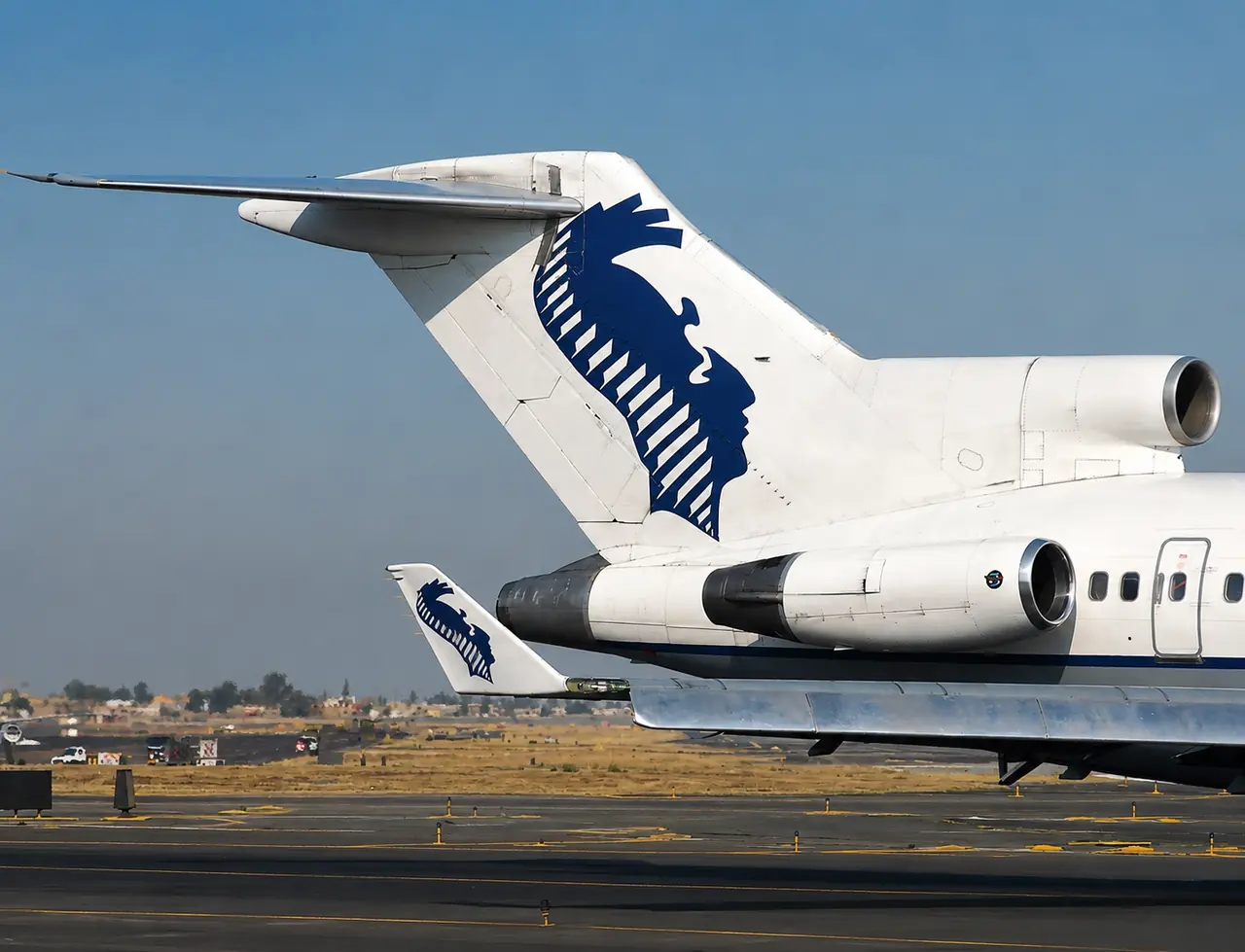
In 1995 Aviacsa adopted the livery people still remember: white aircraft with blue stripes and a smile painted on the front of the fuselage, an idea Pacific Southwest Airlines had made famous in the United States.
The logo was a stylized head of Pakal, the Maya king buried in the Temple of the Inscriptions at Palenque, in Chiapas. It was a constant nod to the airline’s roots. Whether the jets were crossing the Gulf of Mexico or landing in Monterrey, they carried an image of the pre-Hispanic southeast with them, and aviation writers took to calling the airline the flying King Pakal.
Over two decades Aviacsa flew a remarkable variety of aircraft: IAI Aravas and F-27s at first, then BAe 146s, Fokker 100s, Boeing 727-200s, Douglas DC-9s and finally Boeing 737-200s and 737-300s. By 2009 its 25 Boeing 737s averaged 23 years old, far older than the jets flown by its low-cost rivals, and they burned about 20% more fuel than modern models. That aging fleet would weigh heavily in its downfall.
The peak: 3.7 million passengers and routes to the United States
From 2000 to 2005 Aviacsa had its best years. It served 25 destinations in Mexico and flew regularly to five US cities: Chicago, Houston, Los Angeles, Miami and Las Vegas. The regional carrier from Chiapas was long gone.
Its US routes relied mostly on Mexicans living in the United States flying home to visit family. Demand was steady and price-sensitive, which was exactly where Aviacsa could undercut the big American carriers.
In 2005 the airline hit its high-water mark: 3.7 million passengers, roughly 13% of the Mexican market, behind only Mexicana and Aeromexico. That same year it launched online ticket sales and a frequent flyer program, Aviacpass.
It looked as if Aviacsa had left its early troubles behind. King Pakal was flying high.
Related: Aeromexico accidents: the complete history (in Spanish)
The perfect storm: low-cost rivals, jet fuel and recession
Mexico’s airline market changed radically after 2005, when three low-cost carriers appeared: Interjet, VivaAerobus and Volaris. All three flew newer, more fuel-efficient fleets, ran leaner cost structures and sold fares Aviacsa could not match without losing money.
Fuel hit hardest. Between 2006 and 2008 the price of jet fuel rose 133%. For an airline whose old jets burned 20% more than modern ones, that was devastating.
Toward the end of 2007, traffic from Mexicans living in the United States also fell, as US immigration enforcement tightened and remittances dropped. Aviacsa dropped four of its five international routes, Chicago, Houston, Los Angeles and Miami, and kept only Las Vegas.
That same year it emerged that Aviacsa had held talks with Interjet about a possible sale. The deal fell through over price. By then Aviacsa had slipped from third to fifth place in the market, overtaken by the low-cost newcomers.
2008 made things worse. Aviacsa closed six more domestic destinations, Mexicali among them, and cut its fleet by a quarter. Capacity fell 36% and the year ended in the red. Then, in April 2009, the H1N1 flu epidemic froze tourism in Mexico; the air travel market shrank 12% in the first quarter alone.
Aviation consultant Pete Garcia called it “the perfect storm.”
The 2009 groundings: maintenance, debt and claims of persecution
On June 2, 2009, the SCT’s civil aviation directorate (DGAC) took an unprecedented step and grounded 25 of Aviacsa’s 26 aircraft, citing irregularities in its inspection, quality control and maintenance systems.
Three days later, in an equally unusual turn, Aviacsa won a federal injunction from a district judge in San Luis Potosi and resumed flying. On June 12, the US Federal Aviation Administration barred Aviacsa from operating its Monterrey to Las Vegas route “until it corrects the safety deficiencies identified.”
The final blow came on July 6. The SCT ordered a second suspension over a debt of 292 million pesos owed to SENEAM, the agency that provides radar and air traffic control services to every airline operating in Mexico. Aviacsa’s fleet never flew again after that day.
Every day on the ground cost the company 10 million pesos. Total liabilities were around 600 million pesos: 293 million to SENEAM, 42 million to Mexico City airport (AICM) in passenger airport fees (TUA) and about 260 million to ASA, the state fuel supplier, for jet fuel.
Aviacsa did not go quietly. It argued that it had overpaid SENEAM by more than 350 million pesos in previous years, a credit Mexico’s tax authority (SAT) had recognized for Aeromexico and Mexicana but not for Aviacsa. Its executives went further and accused the government of acting under pressure from other airlines to get rid of a competitor.
“If it hadn’t been for these decisions by the authorities, our 2009 results would have been very positive. We had turned the numbers around and raised our load factor,” Aviacsa’s legal director, Haydee Cordova, told Expansion magazine in August 2009. The SCT never publicly answered the accusation.
3,500 workers in limbo
The shutdown in July 2009 was a human crisis as much as a business one. Aviacsa directly employed 3,500 people: pilots, flight attendants, engineers, mechanics, technicians and office staff. With the planes parked and no return date in sight, all of them were left hanging.
In mid-July 2009, employees held protests in the cities Aviacsa served. They wrote to President Felipe Calderon and to the finance and labor secretaries, demanding that the government recognize the SAT credit and let the airline fly again. They got no answer.
The rescue that never took off
With operations suspended and debts piling up, Aviacsa filed for bankruptcy protection (concurso mercantil) in July 2009. Management looked for investors to recapitalize or buy the company, and Grupo Madero eventually acquired almost 100% of the shares. The plan was to restructure the debt, get new certifications and relaunch in 2011.
In April 2011 Aviacsa announced it would fly again. On April 4 its official Twitter account posted that operations would start on May 2 to Cancun, Mexico City, Merida, Monterrey, Tapachula, Tuxtla Gutierrez and Villahermosa. Tickets went on sale.
On May 4, 2011, the airline said it would stop selling tickets. Unpaid debts to Mexico City airport and to Grupo Aeroportuario del Pacifico (GAP) were keeping it out of airport facilities. The relaunch never happened, passengers who had bought tickets were left without flights, and Aviacsa never flew again.
What was left of Aviacsa
Aviacsa’s disappearance left gaps and a few prized assets. The most valuable were its 90 daily slots at Mexico City International Airport, a scarce resource at a congested hub. During the 2009 crisis Volaris was mentioned as a possible bidder, although it formally ruled that out.
Once Aviacsa was gone, several of its routes were picked up by Aeromexico Connect, the group’s regional subsidiary. The market moved into the consolidation analysts had predicted in 2009, when they argued Mexico could sustain five airlines, not eight.
Today aviation buffs remember Aviacsa with mixed feelings. It connected the southeast with the rest of the country for almost two decades, flew to Las Vegas with King Pakal on the tail and smiled from its fuselages. It also ran up 600 million pesos in debt, left 3,500 people out of work and disappeared amid questions about whether the government treated it fairly. Those questions never got an official answer.
Aviacsa was formally founded on May 5, 1990, as Consorcio Aviaxsa S.A. de C.V. by the state government of Chiapas. It stopped for good on May 4, 2011, when it suspended ticket sales and abandoned its relaunch plans.
Several things hit at once: competition from new low-cost carriers (Interjet, VivaAerobus, Volaris), a 133% rise in jet fuel prices between 2006 and 2008, the 2009 recession, the H1N1 flu epidemic and SCT groundings over maintenance irregularities and a 292 million peso debt to SENEAM.
In 2005, its peak year, Aviacsa carried 3.7 million passengers, about 13% of the Mexican market. It was then the country’s third-largest airline, behind Mexicana and Aeromexico.
Flight 100 was the worst accident in Aviacsa’s history. On May 10, 1990, five days after the airline was founded, the plane crashed on approach to Tuxtla Gutierrez. Twenty-four people died, including the Bishop of Tapachula, Luis Miguel Canton Marin. Most passengers were pilgrims traveling to see Pope John Paul II.
Aviacsa directly employed 3,500 people when it was grounded in 2009. When Grupo Madero’s rescue failed in 2011, they lost their jobs. In 2009 they protested and wrote to the federal government asking for the airline to be allowed to fly again.
At its largest, Aviacsa flew to Chicago, Houston, Los Angeles, Miami and Las Vegas. After demand fell, it cut every US route except Las Vegas, which it kept until the end.
Recommended reading
- Mexicana Airlines history
- Defunct Mexican airlines (in Spanish)
- Aeromexico accidents: the complete history (in Spanish)