

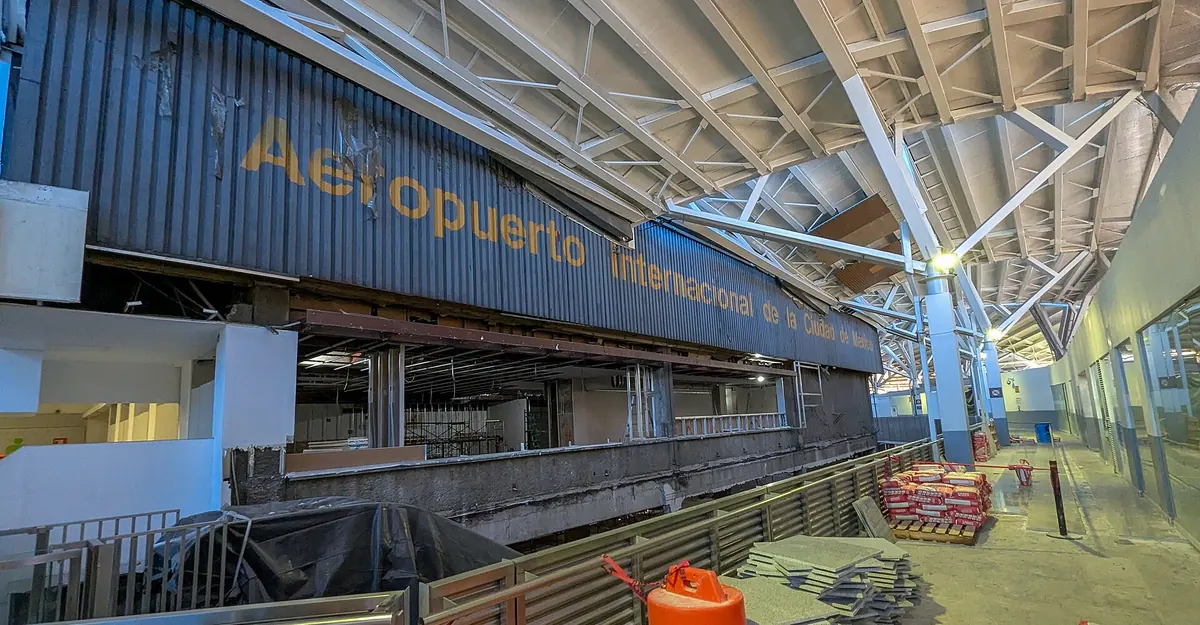
The Mexico City airport renovation moved into its second phase in August 2026 and will not wrap up this year. Benito Juárez International (AICM) itself said work will continue “for the rest of the year and throughout 2027,” with projects in Terminal 1 waiting areas, Terminal 2’s air conditioning and parking garage, and the fire protection systems of both buildings. All of it with the airport open and no cuts to landings or takeoffs.
If you fly in December, that means hallways lined with construction panels, walking routes that shift from one week to the next and lines that grow without warning. Aeronotas went through the airport’s and the Mexican presidency’s announcements since May 2025 to sort out what is done, what comes next and what to plan for when you arrive.
| Stage | Period | What it covers | Status |
|---|---|---|---|
| Phase one | May 2025 to May 2026 | Gate lounges, immigration, customs, baggage claim, restrooms, drainage, hallways, facades and roads at T1 and T2 | Delivered May 30, 2026 |
| Pause | June and July 2026 | No new work during the World Cup | Completed |
| Phase two | August 2026 into 2027 | Waiting areas and a passenger-flow corridor at T1; air conditioning, parking garage and ramps at T2; lightning rods, fire systems and CT baggage scanners at both | Under way |
What phase two of the Mexico City airport renovation includes
The August 5, 2026 statement (in Spanish) lists the main projects. They are less visible than phase one, but several hit exactly where passengers spend the most time: the gate areas and the security checkpoints.
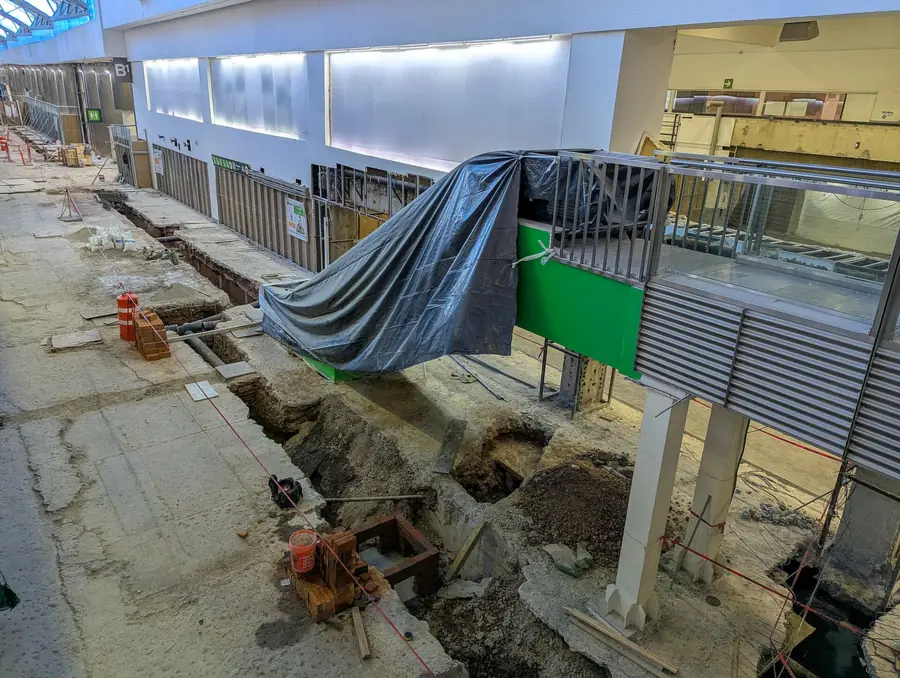
- Terminal 1: larger waiting areas and a new corridor to separate passenger flows in the domestic zone.
- Terminal 2: a new air conditioning system, an expanded parking garage and releveled vehicle ramps.
- Both terminals: new lightning rods and fire systems, CT scanners for baggage screening and more document-validation equipment at checkpoints.
- A new Command and Control Center for airport security, already under construction.
The airport added that some phase-one projects did not stop during the World Cup “because of their nature” and are due to finish this year. It did not say which ones.
Terminal 1: waiting areas and a corridor to split flows
Terminal 1 is the older building and has carried most of the work. In phase one, gates 29 to 36 in Module XI, used for international flights, were fully rebuilt and opened by President Claudia Sheinbaum in August 2025. The domestic gates came next: by December 15, 2025, 24 of 33 positions had been redone, roughly 70% of the boarding lounges in the old section.
Now the job is to enlarge those lounges and build the corridor that separates departing and arriving passengers in the domestic area. Domestic travelers are the ones most likely to notice, because it changes the walk to the gate.
Terminal 2: air conditioning, parking and ramps
At Terminal 2, phase two is about building systems: the air conditioning, the expansion of the parking garage and the vehicle ramps that climb to the departures level.
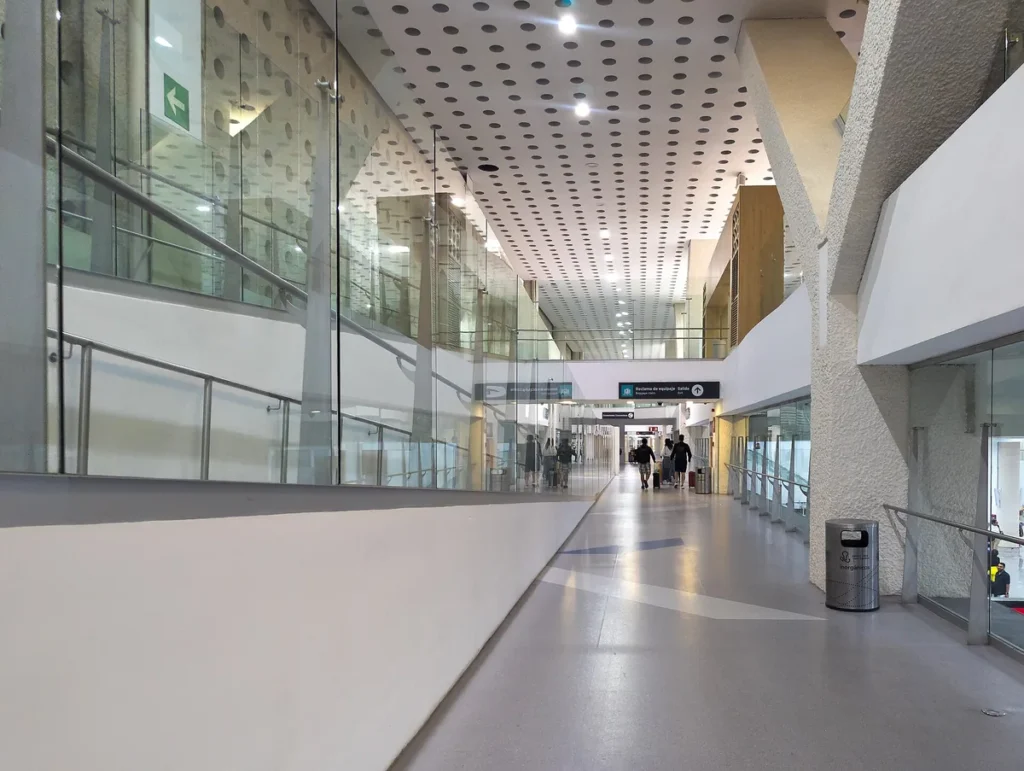
Parking at this terminal already changed in April 2026: levels 3 and 4 reopened with 709 spaces, a third lane was added around the access traffic circle and the exit toward Avenida Fuerza Aérea Mexicana widened to four lanes. Payment is by app, and the airport recommends using it to get out faster.
Where to park while the work continues
In its April 2026 notice (in Spanish), AICM listed three alternate lots for drivers while the garages are renovated:
- Gate 6 of the Magdalena Mixhuca sports complex, with a free van shuttle to Terminal 1 and Terminal 2.
- A lot next to the Terminal 2 traffic circle, before the vehicle ramp.
- A lot east of Terminal 2, on Alberto Santos Dumont and Juan Guillermo Villasana streets.
The notice did not publish rates for those lots. With the garage expansion under way, check on the day of your flight which ones are still open.
What phase one already delivered
On May 30, 2026, the presidency handed over phase one, a 6.5 billion peso investment (about 355 million USD). According to Admiral Juan José Padilla Olmos, head of Grupo Aeroportuario Marina and AICM, the full package adds up to 106 projects and 10 billion pesos (roughly 545 million USD).
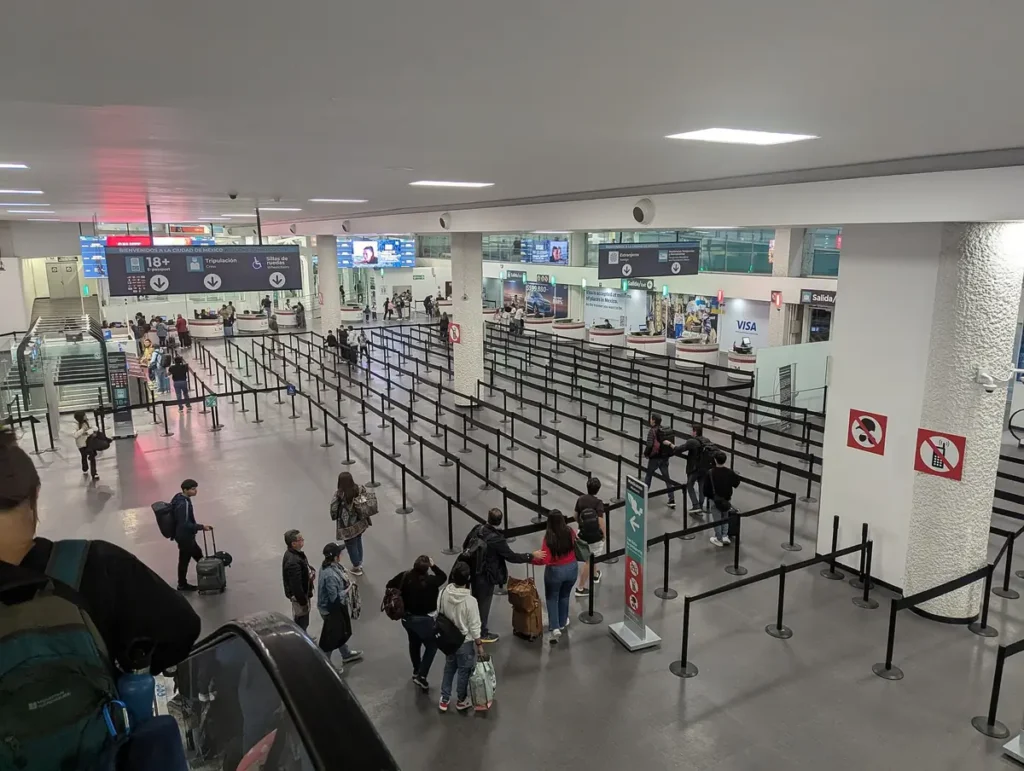
That stage covered gate lounges, immigration, customs, baggage claim, restrooms, drainage, hallways, facades and roads at both terminals. On the operations side, the airport announced capacity for 46 operations per hour starting June 1, a new airport management system built to IATA standards, two rapid-exit taxiways (D1 and D2), anti-drone protection and an upgraded free Wi-Fi network.
Who pays for the AICM renovation
A detail that often gets lost: the work does not come out of the federal budget. At the May handover, the president said the 6.5 billion pesos were covered by the airport’s own revenue, what it earns from fees and services, with no tax money.
That includes the airport use fee (TUA) every passenger pays (in Spanish). In other words, the people who use the airport are funding the renovation. The test at the end is whether those 10 billion pesos turn into shorter lines, enough lounge space and a building that can handle the 44 to 45 million passengers AICM reports each year, without the work dragging on indefinitely.
The timeline has changed twice
In May 2025, AICM said phase one would end in May 2026 and phase two would run from August to December 2026. It repeated that in December 2025. When phase two started in August 2026, the schedule stretched into 2027 with no end date.
At the May handover, the president also spoke of “a second and third stage that we are still going to develop.” So far there is no statement defining the scope of a third phase.
What to plan for when flying out of AICM
Since its first notice, the airport has asked travelers to arrive early while the work lasts. With Christmas departures (in Spanish) around the corner, three things help:
- Confirm your terminal on the boarding pass. The Aerotrén linking Terminal 1 and 2 runs from 5:00 a.m. to 11:00 p.m. and is suspended during major maintenance; on those days the airport runs buses between terminals, which take longer.
- Have your ID ready. Travel documents (in Spanish) are checked at the screening points where the new validation equipment is going in.
- Pack light in the cabin. With CT scanners being installed, checkpoints may move slower; sticking to carry-on size limits (in Spanish) avoids extra inspections.
If your flight allows it, Felipe Ángeles International (AIFA) is the other airport serving the Mexico City area. It now has a train from Buenavista station and several bus routes; details are in our guide on how to get to AIFA (in Spanish).
Mexico City airport renovation: frequently asked questions
When will the Mexico City airport renovation be finished?
The airport has not given a date. Its latest statement, from August 2026, says phase two will continue through the rest of 2026 and throughout 2027.
Are flights being canceled because of the work?
No. Both phases are being carried out without suspending landings or takeoffs. What changes are entrances, hallways and lounges inside the buildings.
How much does the renovation cost?
10 billion pesos in total (roughly 545 million USD), according to Grupo Aeroportuario Marina. Phase one cost 6.5 billion pesos and was paid with the airport’s own revenue.
Which terminal has more construction?
Both have active work in this stage. Terminal 1 is enlarging its domestic waiting areas; Terminal 2 is working on air conditioning, parking and ramps.
How early should I get to Mexico City airport?
The airport has not set a figure for the construction period; it only asks passengers to arrive early. Airlines keep their own check-in cutoffs, which you can see on your boarding pass. Volaris’s are in our guide to Volaris online check-in.
Recommended reading
- Volaris Online Check-In: When It Opens and How It Works
- Mexican Airlines Pet Policy: Volaris, Viva, Aeroméxico
- How to get to AIFA: train, bus, car and taxi (Spanish)
- Airport use fee (TUA) in Mexico by airport (Spanish)