

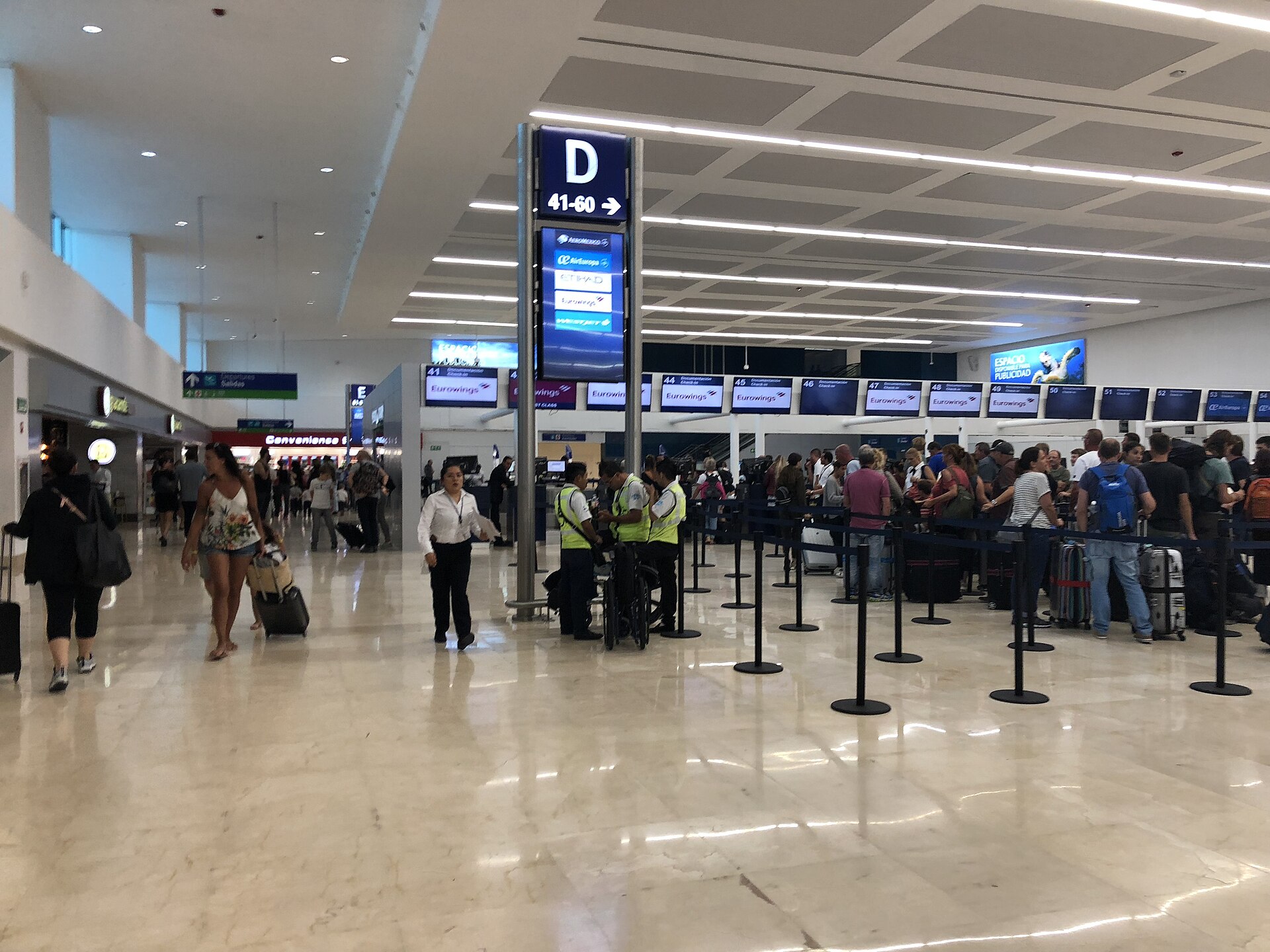
Cancun airport passenger numbers fell 7.7% in October 2026, and the drop was not limited to the Caribbean. Mexico’s two largest listed airport groups both reported fewer travelers than a year earlier: ASUR handled 2.80 million passengers at its nine Mexican airports, down 5.4% from October 2025, while OMA closed the month with 2.29 million across its 13 terminals, a 4.8% decline. Both groups released their figures on November 5.
Cancun took the biggest hit.
Cancun International Airport served 1,893,436 passengers, 157,217 fewer than a year before. Almost three quarters of that loss came from international flights, which carried 1,100,099 travelers, 9.5% below October 2025. Domestic traffic also slipped, though by less: 5.0%.
Cancun airport passenger numbers and other airports, October 2026
Aeronotas pulled the busiest airports of both groups into one table using their official traffic reports. ASUR’s numbers exclude transit passengers and general aviation; OMA’s include general aviation and exclude transit. Compare the percentage changes rather than adding the totals together.
| Airport | October 2025 | October 2026 | Change |
|---|---|---|---|
| Cancun (ASUR) | 2,050,653 | 1,893,436 | -7.7% |
| Monterrey (OMA) | 1,345,529 | 1,244,885 | -7.5% |
| Merida (ASUR) | 330,325 | 332,242 | +0.6% |
| Chihuahua (OMA) | 177,457 | 176,043 | -0.8% |
| Culiacan (OMA) | 167,912 | 160,365 | -4.5% |
| Ciudad Juarez (OMA) | 184,734 | 159,929 | -13.4% |
| Oaxaca (ASUR) | 158,525 | 152,505 | -3.8% |
| Veracruz (ASUR) | 163,144 | 152,555 | -6.5% |
| Villahermosa (ASUR) | 114,764 | 120,795 | +5.3% |
| Mazatlan (OMA) | 121,276 | 114,721 | -5.4% |
| San Luis Potosi (OMA) | 73,783 | 90,527 | +22.7% |
| Torreon (OMA) | 73,369 | 79,515 | +8.4% |
Cancun is down almost 1.5 million passengers this year
October was not a one-off for Cancun. Year to date, the airport has handled 22.78 million passengers, 6.1% fewer than in January through October 2025, and cumulative international traffic is down 6.7%. For the Mexican airport with the most international travelers, that adds up to nearly 1.5 million fewer people in ten months.
The rest of southeastern Mexico was uneven. Veracruz fell 6.5% and Oaxaca 3.8%, while Villahermosa gained 5.3% and Tapachula 18.6%, the latter on a small base of 45,430 passengers for the month. Huatulco and Cozumel were essentially flat.
Merida, the exception in ASUR’s network
Merida airport was one of the few in positive territory: 332,242 passengers, 0.6% more than last October. The lift came from international traffic, up 16.8% to 33,043 travelers, since domestic slipped 0.9%. Year to date, Merida is up 5.5% and has already passed 3.38 million passengers.
OMA: Monterrey drags the group down

At OMA the problem is almost entirely domestic. Domestic passengers fell 6.5% to 1,952,765, while international passengers rose 5.9% to 341,494. Monterrey airport, which accounts for more than half of the group’s traffic, lost 10.4% of its domestic passengers in the month and only partly offset that with an 8.8% increase on international flights. The result: 1,244,885 passengers, down 7.5%.
Ciudad Juarez posted the steepest drop in the group at 13.4%. At the other end, San Luis Potosi grew 22.7%, Durango 16.6% and Torreon 8.4%. Even after a weak October, OMA is up 1.3% for January through October, with 23.93 million passengers.
By the numbers: ASUR Mexico 2.80 M passengers (-5.4%) · OMA 2.29 M (-4.8%) · Cancun international -9.5% · Monterrey domestic -10.4% · Merida international +16.8%
Why Mexico’s domestic market is shrinking
The airport reports don’t give reasons, but the airlines’ own numbers offer clues. Volaris cut its domestic capacity by 6.8% in October, measured in available seat miles, and expanded international capacity by 27.5%, mostly to the United States. Its domestic traffic fell 8.4% in the month, and the company said international routes now make up half of its total capacity.
Viva Aerobus said unscheduled Pratt & Whitney engine inspections and fuel prices forced it to trim capacity by 4.4% in the third quarter. With jet fuel at historic highs, Aeromexico, Viva and Volaris have pulled back to their most profitable routes and raised fares: Volaris’s average base fare climbed 25.5% in that quarter.
For travelers, that means fewer frequencies on domestic routes and pricier tickets. The bigger question is how many of the people that low-cost carriers brought into the air over the last decade are now being priced out, something that will also weigh on the Viva-Volaris merger.
The international side has a different backdrop. The United States lifted its restrictions on Mexican airlines in early November, so any new routes that follow won’t show up in the statistics before December.
What we still don’t know
GAP, which runs the Guadalajara, Tijuana, Puerto Vallarta and Los Cabos airports, had not yet released its October report when this story was written. That report will complete the picture for Mexico’s three private airport groups. Mexico’s civil aviation agency (AFAC) publishes system-wide statistics later, including Mexico City (AICM) and Felipe Angeles (AIFA).
November brings two tests: Buen Fin, Mexico’s big shopping weekend, with its flight deals, and the start of Cancun’s winter season, which depends on Canadian and American travelers. The sources are the traffic releases from ASUR and OMA.
Recommended reading
- Passenger rights in Mexico: flight delays and refunds
- Tulum airport offers incentives to attract airlines (in Spanish)
- Viva-Volaris merger: what changes for passengers (in Spanish)
- US lifts restrictions on Mexican airlines (in Spanish)
- FAA Category 1: what it means if Mexico loses it (in Spanish)