


For years the standard complaint about Felipe Ángeles International Airport (AIFA) was simple: it was hard to reach. The AIFA train, an extension of the old Suburbano commuter line now called the Tren Felipe Ángeles, started service on April 26, 2026, and it is the first serious answer to that problem. You board at Buenavista, in central Mexico City, and get off inside the airport.
Demand showed up quickly. By mid-June, Mexico’s transport ministry (SICT) reported more than one million passengers on the Lechería-AIFA section in roughly six weeks of operation.
Collecting miles for your next trip? See our guide to the best airline credit cards in Mexico (in Spanish).
A late project, but a finished one
The line was not built from scratch. It extends the commuter rail that already ran from Buenavista to the northern suburbs of the Valley of Mexico. From Lechería, new track heads northeast to the airport through municipalities that have long had few transit options.
Construction ran well behind schedule, with right-of-way disputes and technical changes along the way. It still got done, and the federal government has since bought the Suburbano from its private operator and renamed the whole system after General Felipe Ángeles.
Long layover at the airport? Here is how to get into airport VIP lounges (in Spanish).
AIFA train route: Buenavista to the terminal without transfers
Trains leave Buenavista and follow the existing Suburbano line through stops such as Fortuna, Tlalnepantla and San Rafael. At Lechería the new section begins. According to SICT, it adds six stations and a terminal: Cueyamil, La Loma, Teyahualco, Prados Sur, Cajiga, Xaltocan and Terminal AIFA, about 23 km of new track.
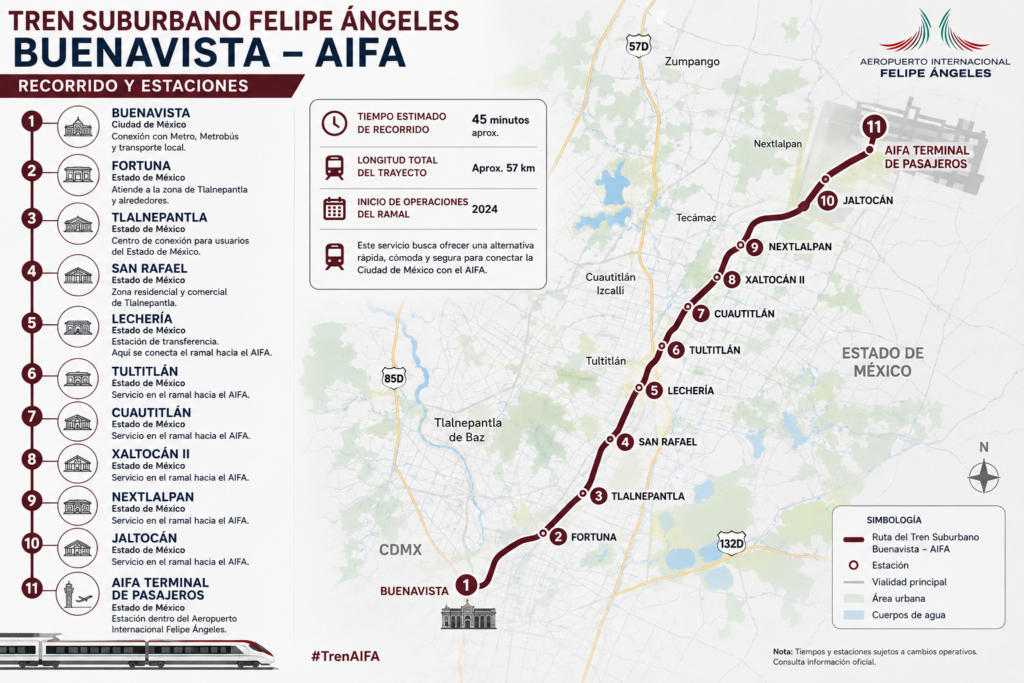
The last stop is the reason the line matters. The station is built into the airport grounds, so there is no shuttle or taxi at the end: you walk from the platform to the passenger terminal.
How long the AIFA train takes
The track was designed for a 43-minute run, but the government said at the inauguration that the trip would start at about an hour and come down as operations settled. In June, SICT put the Buenavista-AIFA ride at roughly 50 minutes, at an average commercial speed of 65 km/h.
What the train really offers is predictability. By road, traffic on the way north can easily double the trip; Banobras, the federal development bank behind the project, says other means of transport can take up to two and a half hours.
Flying to the United States often? Read how Global Entry shortens immigration lines (in Spanish).
Fares and how to pay
When the line opened, the government set a promotional fare for the first month: 45 pesos (about US$2.50) for any trip to or from AIFA, and 11.50 pesos between intermediate stations. Banobras said the permanent fares would be announced near the end of that period, with the promise that they would stay below the cost of other ways to reach the airport. Check the current fare with the operator before you travel.
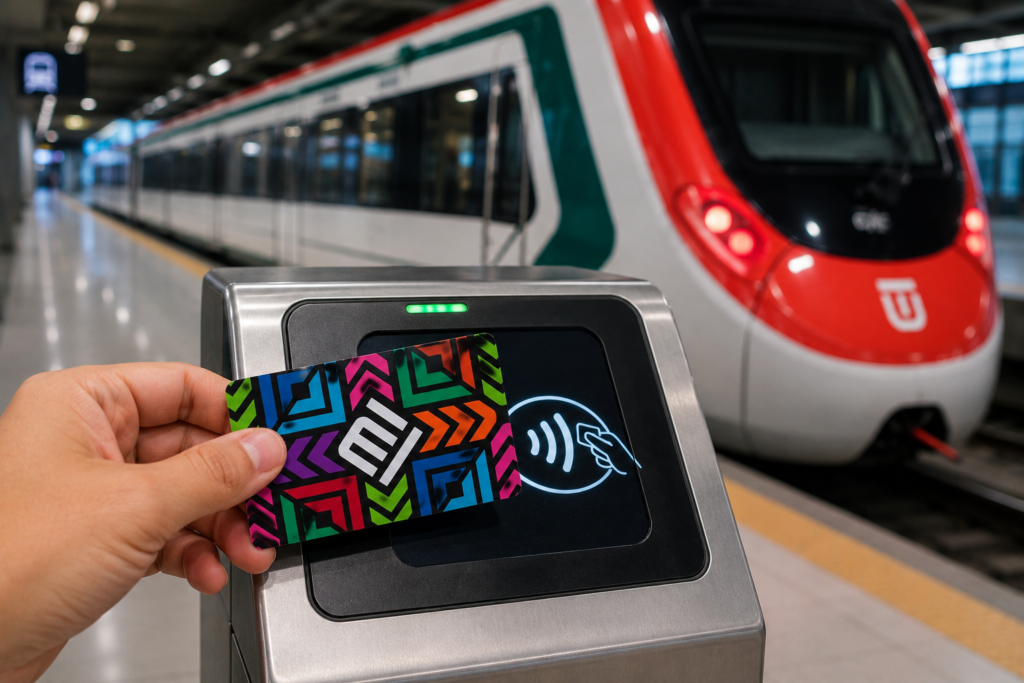
Payment is the detail that trips people up. The new section works with Mexico City’s integrated mobility card, the TUMI, which is tapped at both the origin and the destination station. At launch the older Suburbano card did not work on this section; the federal government said both cards would later become interchangeable, so ask at the station if you only carry the Suburbano card.
Some Mexican airlines are long gone. Look back at Mexico’s defunct airlines (in Spanish).
Schedule
At launch, Banobras published these operating hours: Monday to Friday from 5:00 a.m. to midnight, Saturdays from 6:00 a.m. and Sundays and holidays from 7:00 a.m., also until midnight. Trains ran every 30 minutes at first, with four trains in service and the plan to add the rest of the fleet. For an early-morning flight, check the first departure from your station before counting on the train.
Traveling with luggage
Suitcases are allowed and the cars are roomy. Still, this is a commuter line, not an airport express. At rush hour, with people heading to and from work, a large bag becomes a nuisance for you and everyone around you. If your schedule allows, avoid the peaks.
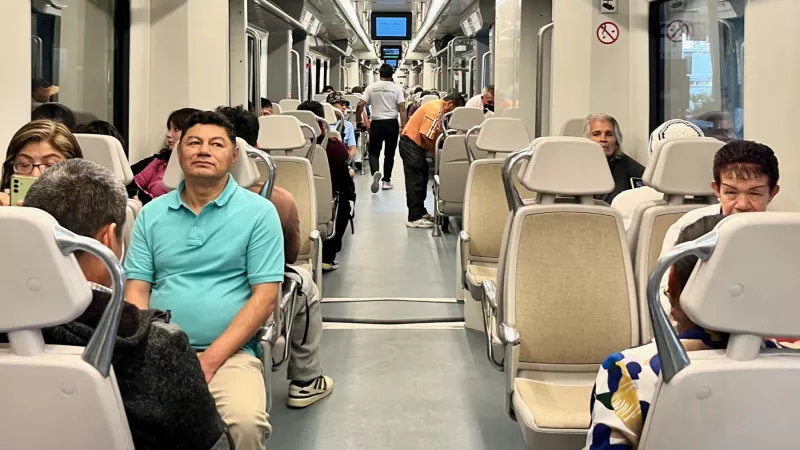
On board it feels like the regular Suburbano: wide cars and air conditioning. Each train is 100 meters long and carries up to 719 passengers, according to SICT, and two trains can be coupled at peak times to move about 1,400 people.
Bumpy flight last time? Find out whether turbulence is getting worse.
Getting to Buenavista
Buenavista is one of the city’s main transfer points, served by the Metro, the Metrobús and plenty of taxis and ride-hailing cars. For anyone staying in the center or along Reforma it is an easy start. From the south of the city, the ride to Buenavista can add a good chunk of time to the total.
Is it better than the alternatives?
For most travelers, yes. It is the cheapest way to reach AIFA, it skips the highway traffic and its travel time does not swing from one day to the next.
A car or a ride-hailing app is still more flexible, especially with family and several bags, but it costs more and depends on traffic. Buses are a valid option and usually slower.
Which carrier lands on time most often? See Mexico’s most punctual airlines.
Is it working?
Ridership says so. A million trips in six weeks shows the need was there and only lacked a usable option. Frequency at some hours and crowding at peak times are the points still to improve, and pressure on the line will grow as AIFA adds flights.
The rail project does not stop at the airport either. The federal government has already started work on the México-Pachuca train, which will continue north from AIFA toward the capital of Hidalgo.
For the first time, getting to AIFA no longer depends entirely on the highway. The train still needs adjustments, but for a flight out of Santa Lucía it is now the option to check first.
Recommended reading
- How to get to Guadalajara airport in 2026 (in Spanish)
- The US lifts restrictions on Mexican airlines at AICM and AIFA (in Spanish)